To request a commision, please email us at hello@pwerle.com.au.


Trevor Nickolls (1949-2012) was a groundbreaking Aboriginal artist whose innovative style reshaped contemporary Australian art. Born in Adelaide, South Australia, he drew inspiration from his cultural heritage and personal experiences, creating artworks that merged ancient traditions with modern themes. Known as the “father of urban Aboriginal art,” Nickolls explored the tensions between spiritual connection to the land and the impact of urbanisation. His work challenged perceptions, emphasising cultural survival and identity.
Trevor Nickolls achieved international recognition when he and Rover Thomas were chosen to represent Australia at the 1990 Venice Biennale with a suite of 30 paintings. His works stood out for their narrative depth, blending humor and sharp social commentary. The autobiographical elements, conveyed through bold and candid imagery, drew attention for their unfiltered honesty and cultural significance.
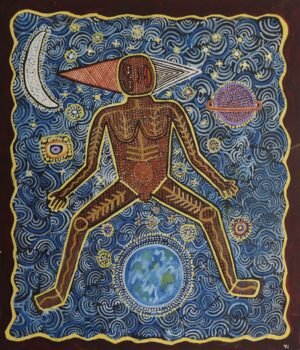
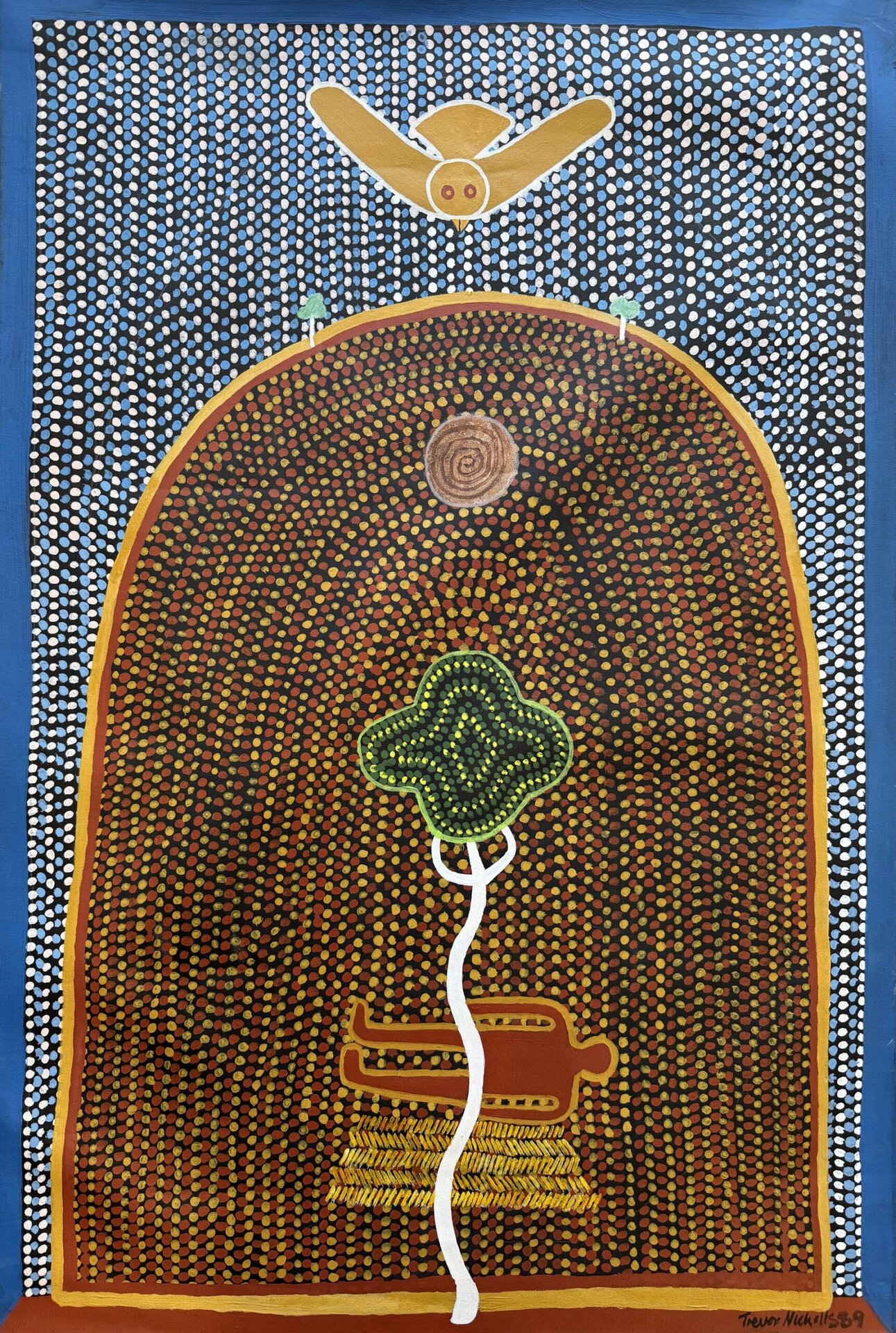
This artwork was produced in 1989, acrylic on linen and is 55cm x 88cm in size.
Artwork is currently unstretched.

Nickolls developed a visual language rich in symbolism, with recurring motifs such as ancestral spirits, nature, and urban landscapes. His 1999 artwork exemplifies his distinctive “Dreamtime to Machinetime” philosophy, blending the organic flow of Indigenous narratives with the rigid structures of industrial society.
Through bold colours and intricate patterns, he conveyed stories of resilience and the evolving Aboriginal identity in a rapidly changing world.
This piece invites the viewer to reflect on the harmony and discord between two worlds.
All the artwork provided is done on with highest quality linen canvas, acrylic paints and brushes ensuring the longevity of each piece of work.