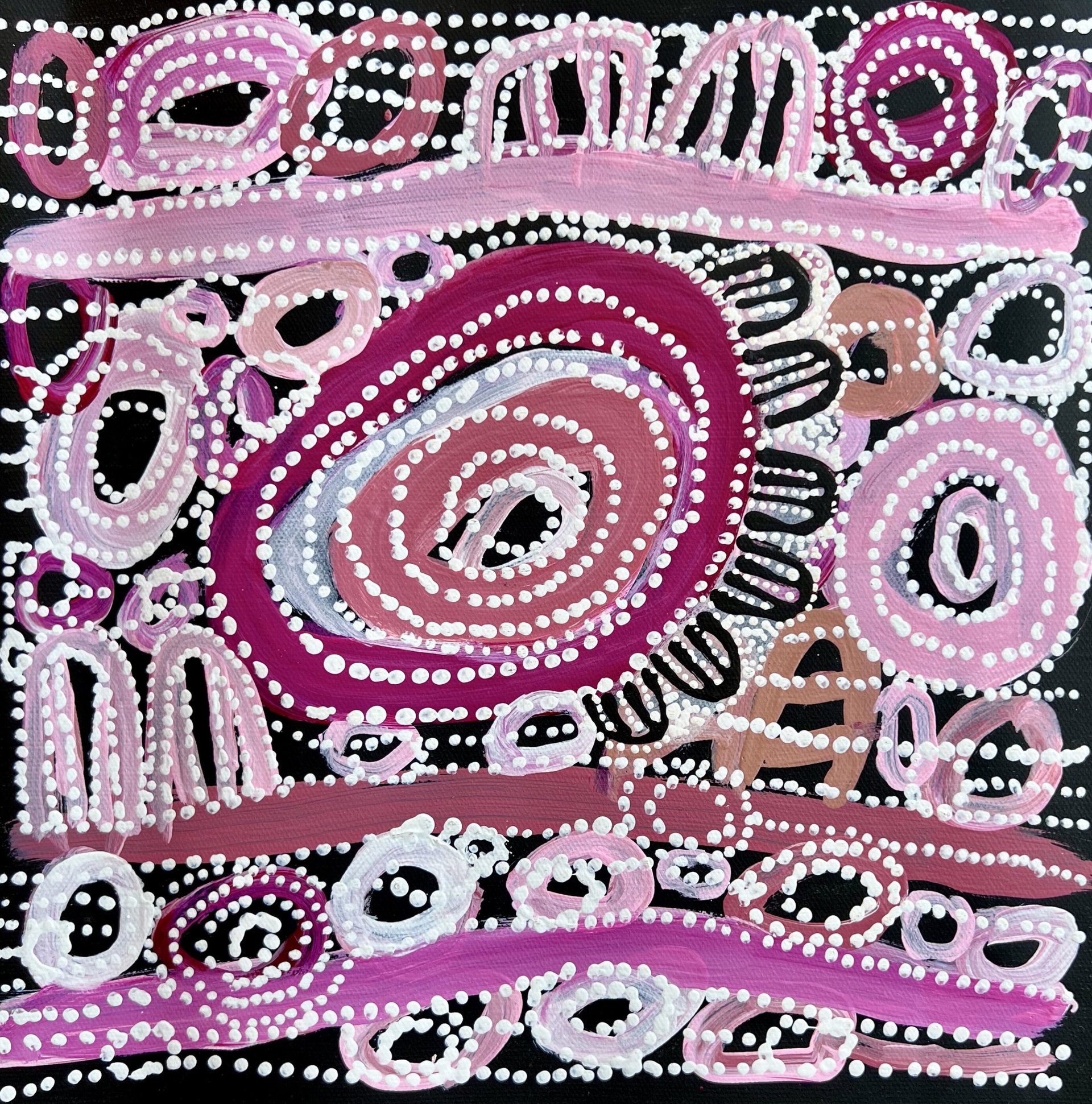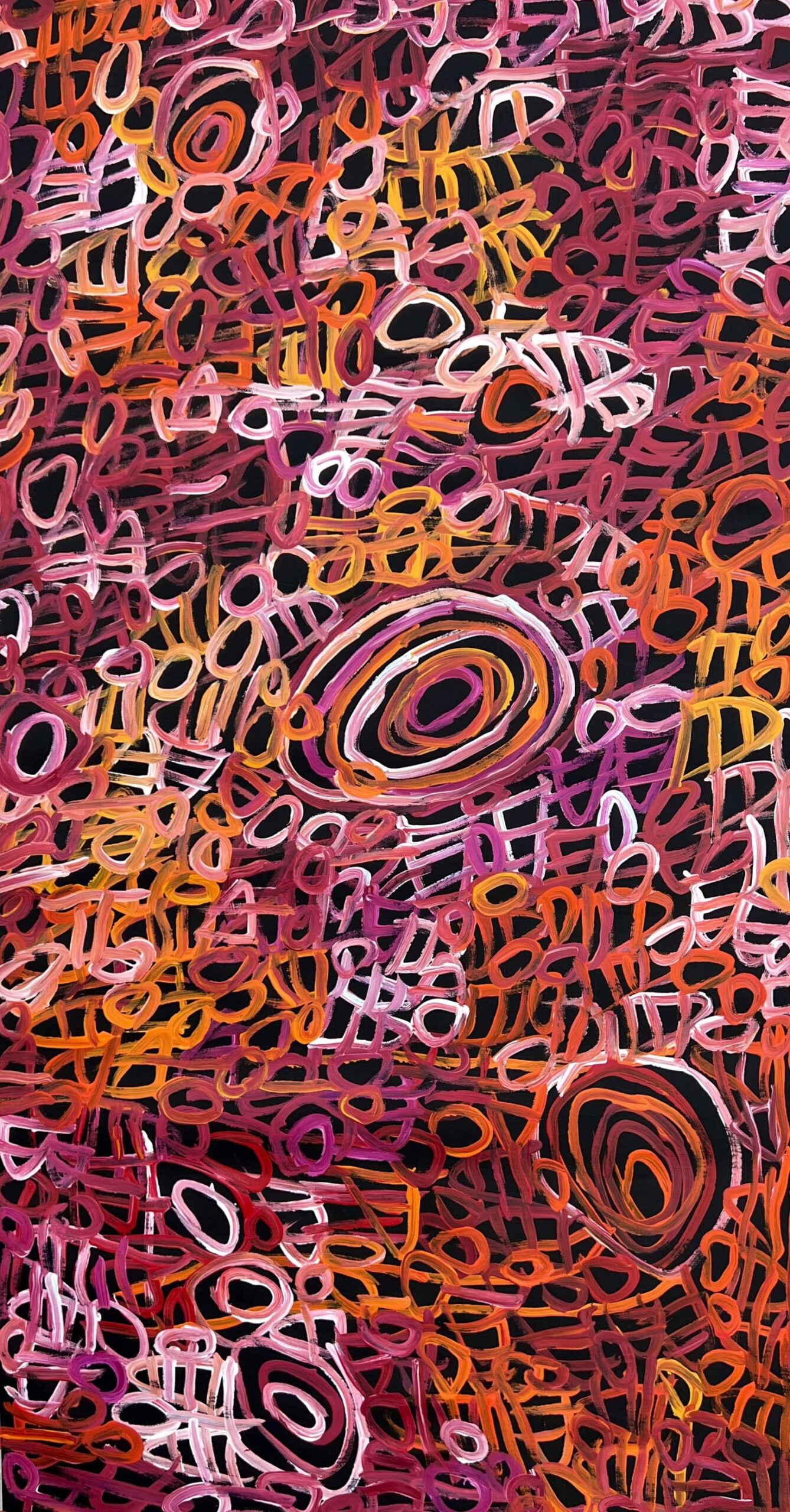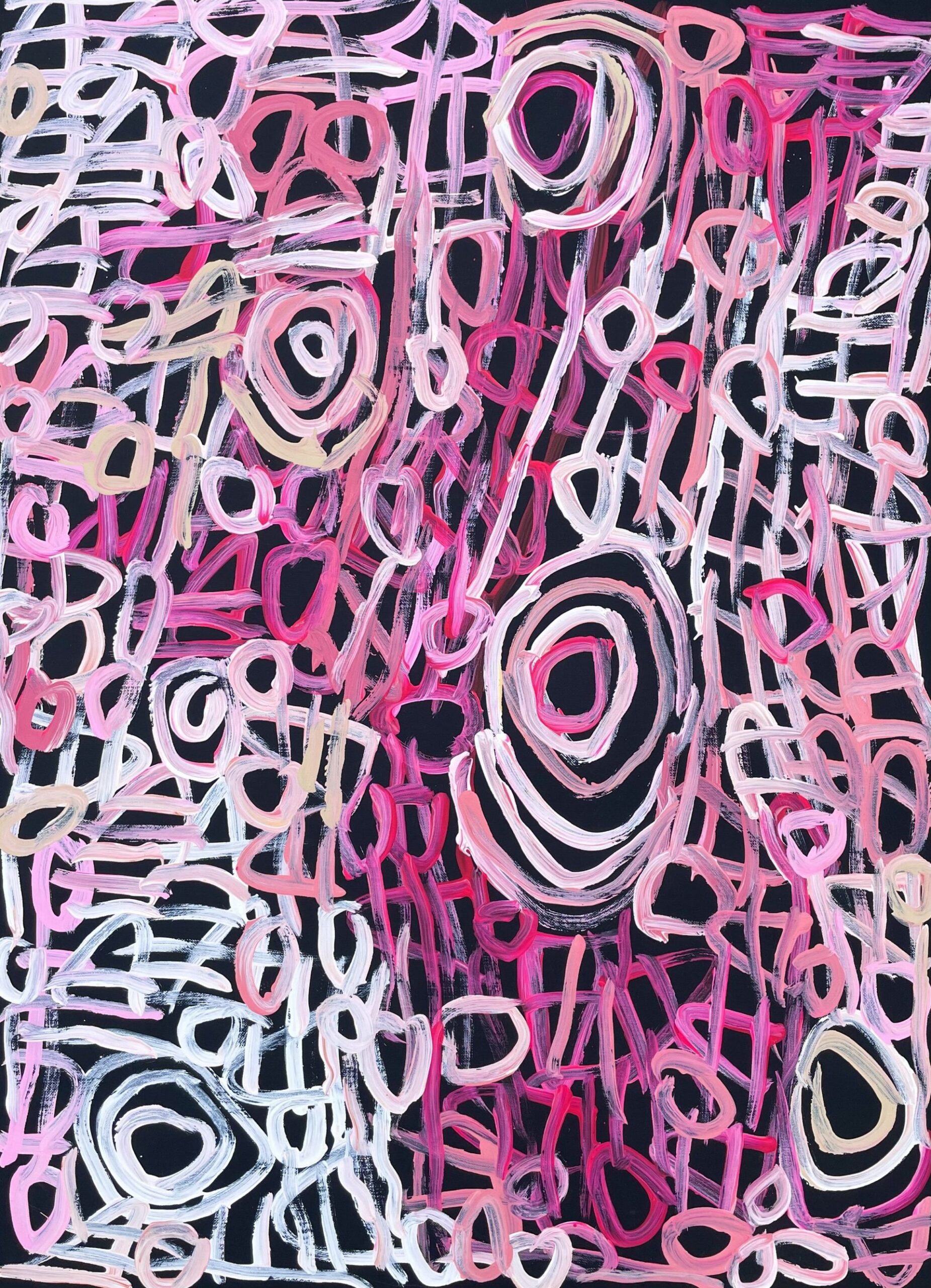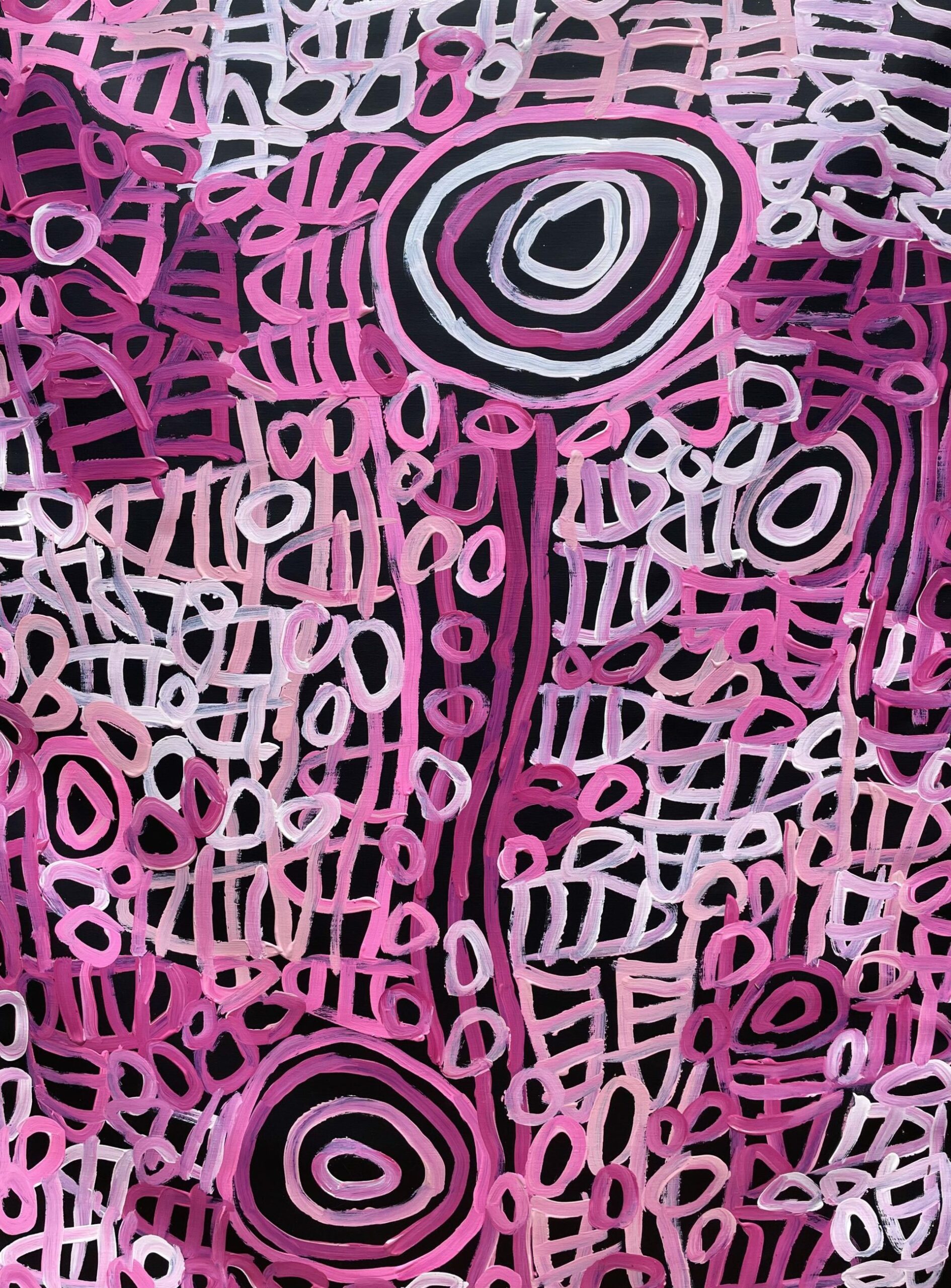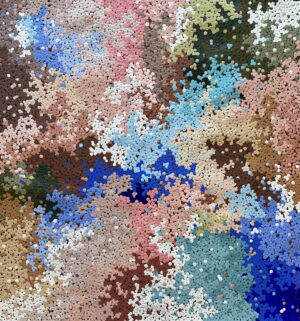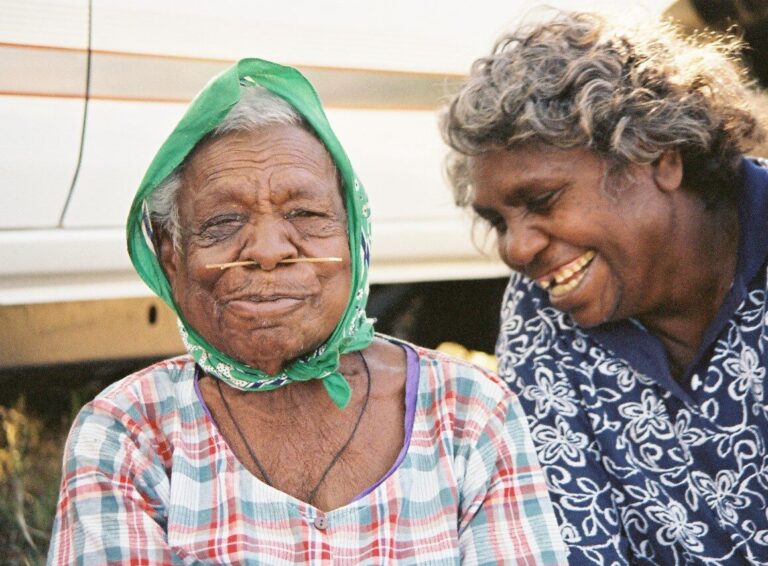
Emily Kame Kngwarreye (c.1910–1996) is celebrated as one of Australia’s most important artists of the 20th century. A senior Eastern Anmatyerre Law woman from Utopia, her cultural authority and radical style have been compared to Monet, Pollock, and Rothko. Born at Alhalkere, she grew up living traditionally on Country before working as a stock hand — unusual for Aboriginal women at the time — a role that showed her strength and independence early in life.
Her principal Dreaming was the Atnwelarr Yam, tied to her father’s Country, and she painted all parts of it — the yam seed, flowers, leaves, cracked earth, and ceremonial Awelye body designs. Emily began her career in 1977 with batik, working alongside other Utopia women and exhibiting internationally through the landmark Utopia – A Picture Story project. In 1987, she turned to acrylic painting, quickly mastering the medium with bold dots, sweeping lines, and luminous colour to translate the stories and ceremonies of her Country onto canvas.
Emily’s rise was extraordinary. Within a decade she had exhibited across Australia, Europe, the USA, and Japan, represented Australia at the Venice Biennale (1993), and won the prestigious Australian Artists’ Creative Fellowship. Her works are held in every major Australian state gallery as well as international collections including the Vatican and leading Japanese museums. In 2017, her 1994 masterpiece Earth’s Creation I sold for AUD $2.1 million, at the time the highest price for an Australian female artist, cementing her place as a global figure in contemporary art.
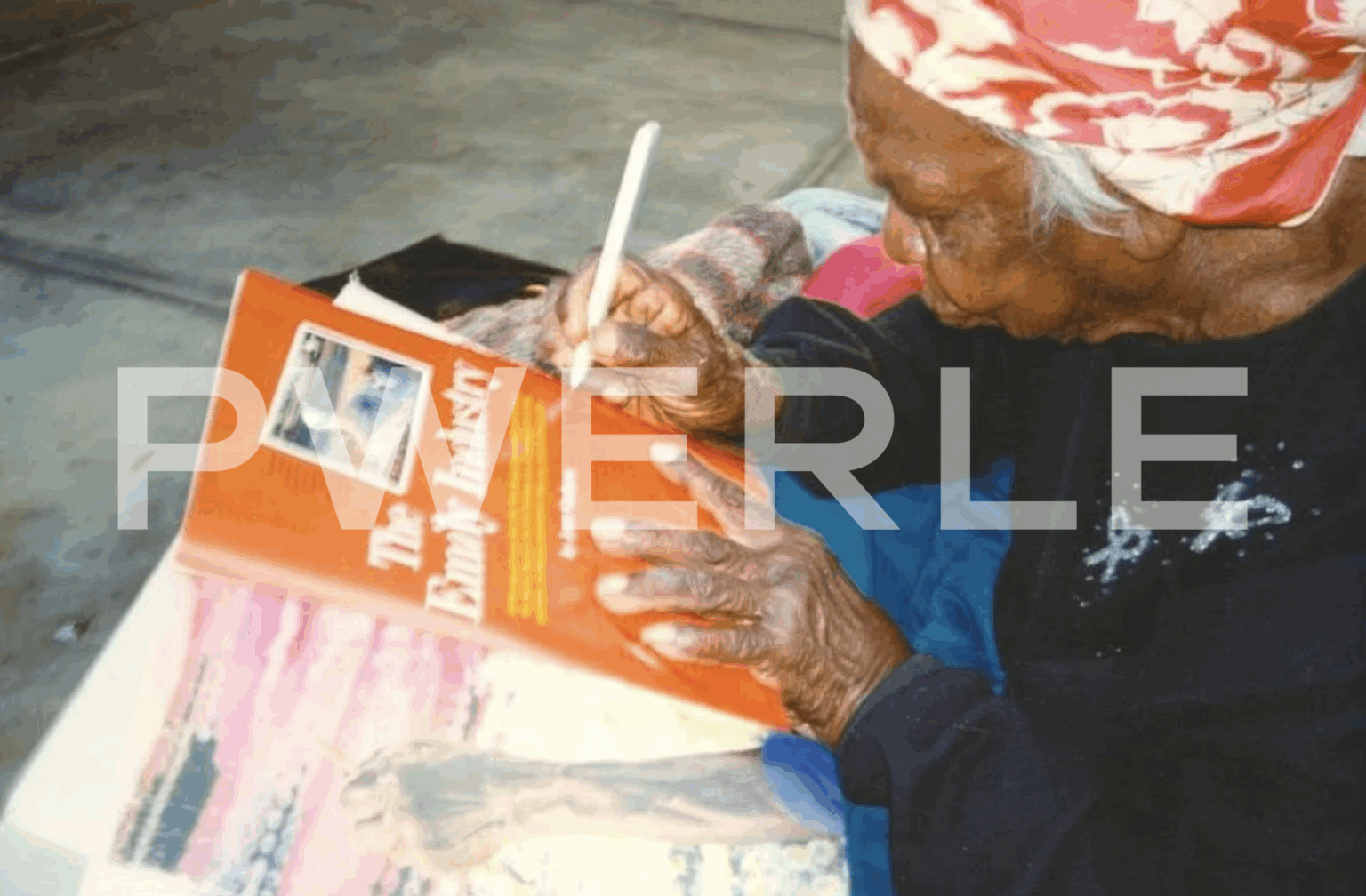
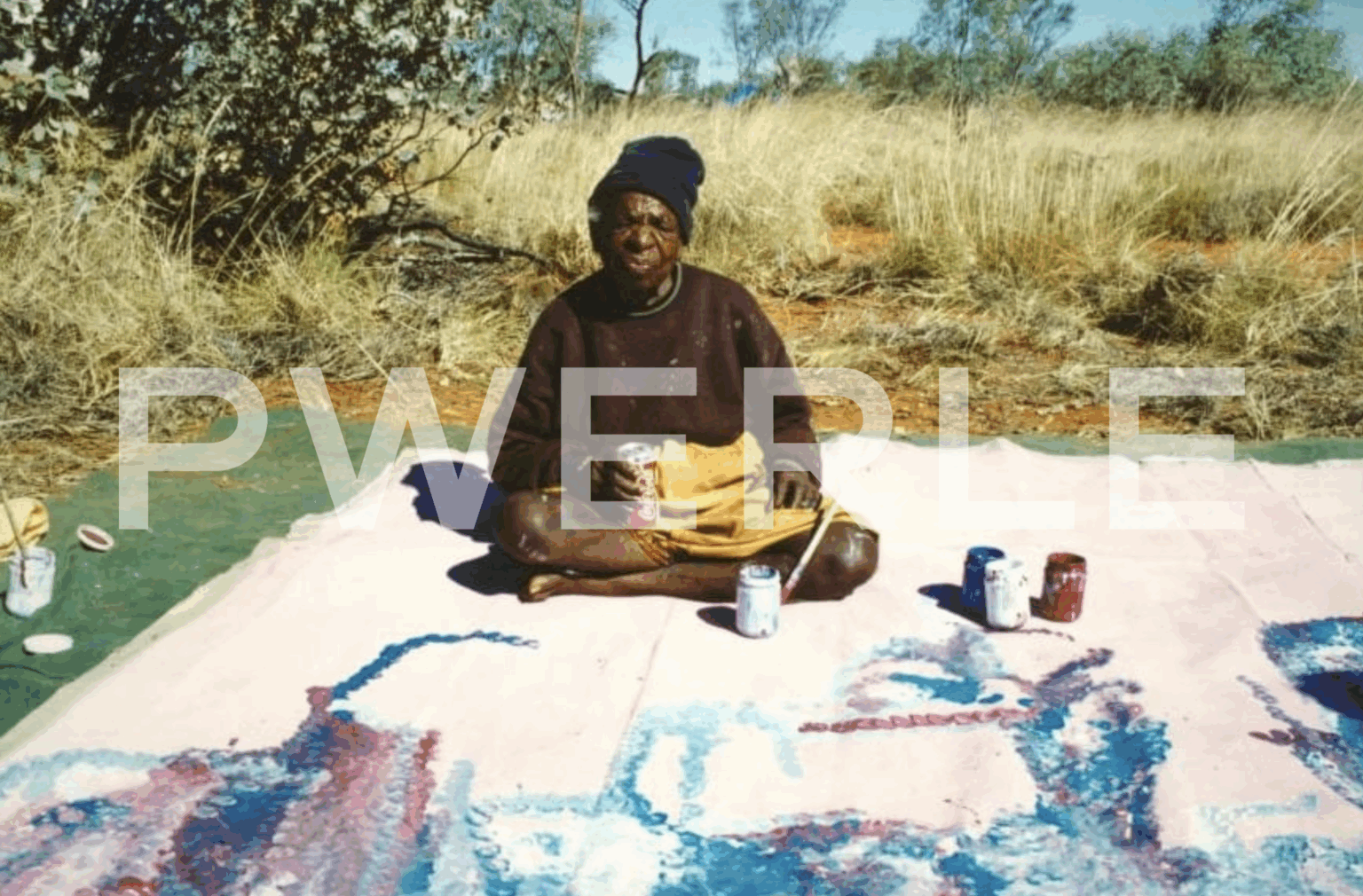
Emily Kame Kngwarreye (c.1910–1996) is recognised as one of the most important Australian artists of the 20th century, a senior Law woman of the Eastern Anmatyerre community at Utopia whose cultural authority and radical painterly innovation have drawn comparisons to Monet, Pollock and Rothko.
Born in about 1910 at Alhalkere, Emily first saw Europeans at the age of nine. She worked as a stock hand on pastoral properties, a role rarely afforded to Aboriginal women, who were more often employed as domestics. This early independence and resilience would define her life and career.
A custodian for her Country, Emily’s principal Dreaming was the Atnwelarr Yam, inherited from her father, and her middle name Kame means yam seed. The perennial yam (Vigna lanceolata) has bright green creeping leaves, yellow flowers and white seeds, with an underground tuber that remains a staple food for the Anmatyerre and Alyawarre women of Utopia. She painted all these aspects of the yam, from the cracking earth signalling tubers below to the ceremonial designs (Awelye) connected to it. Through Aboriginal kinship she also held other Dreamings, including Emu (Ankerrre) and Intekwe, a favoured food of the emu.
Emily began her artistic career in 1977 through a community arts project at Utopia, working in batik with the Utopia Women’s Batik Group. Over a decade, her batik paintings were exhibited widely in Australia and overseas, culminating in the landmark Utopia – A Picture Story project, where 88 silk batiks were acquired for the Holmes à Court Collection and toured across Australia, Ireland and Scotland.
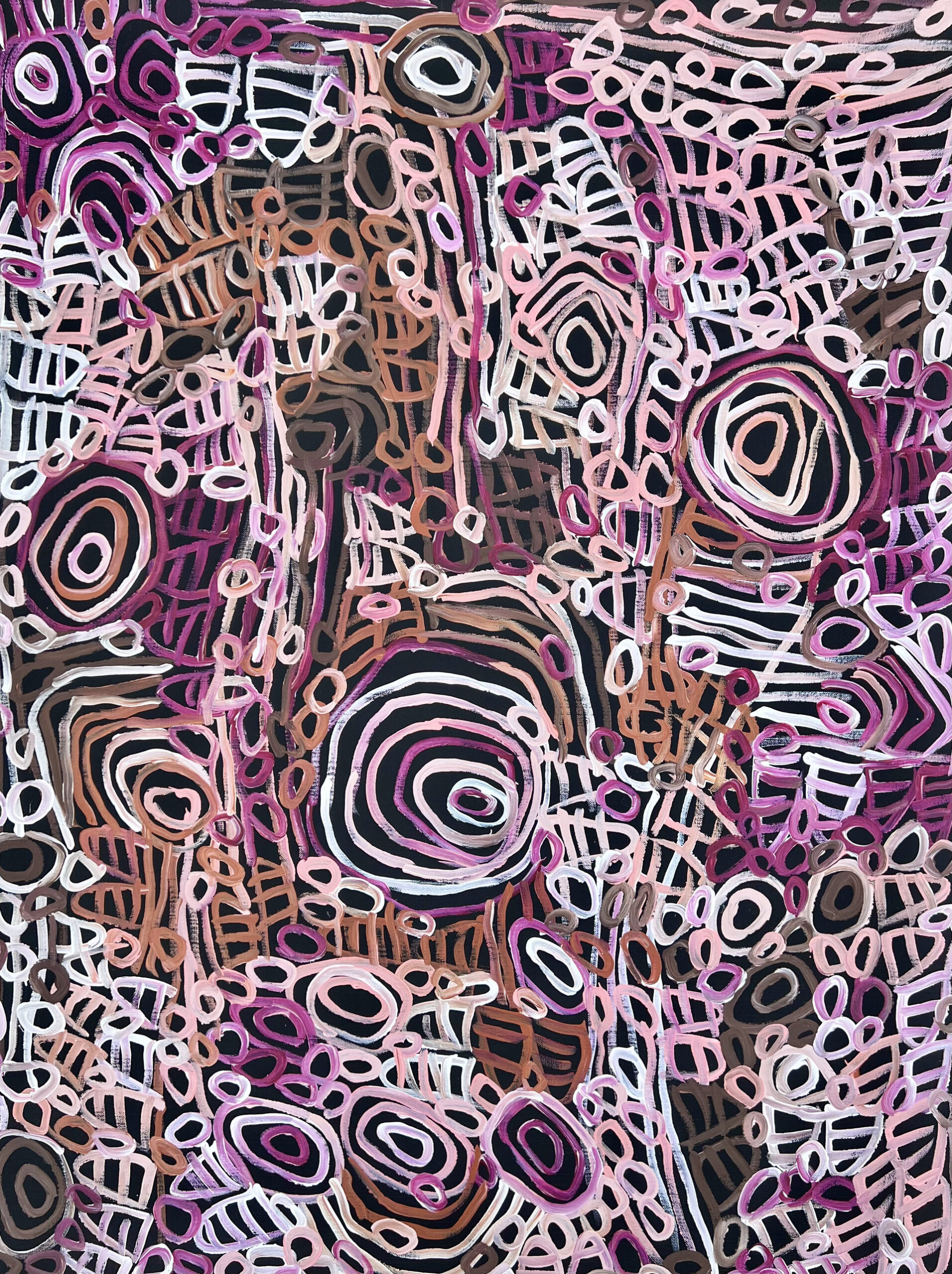
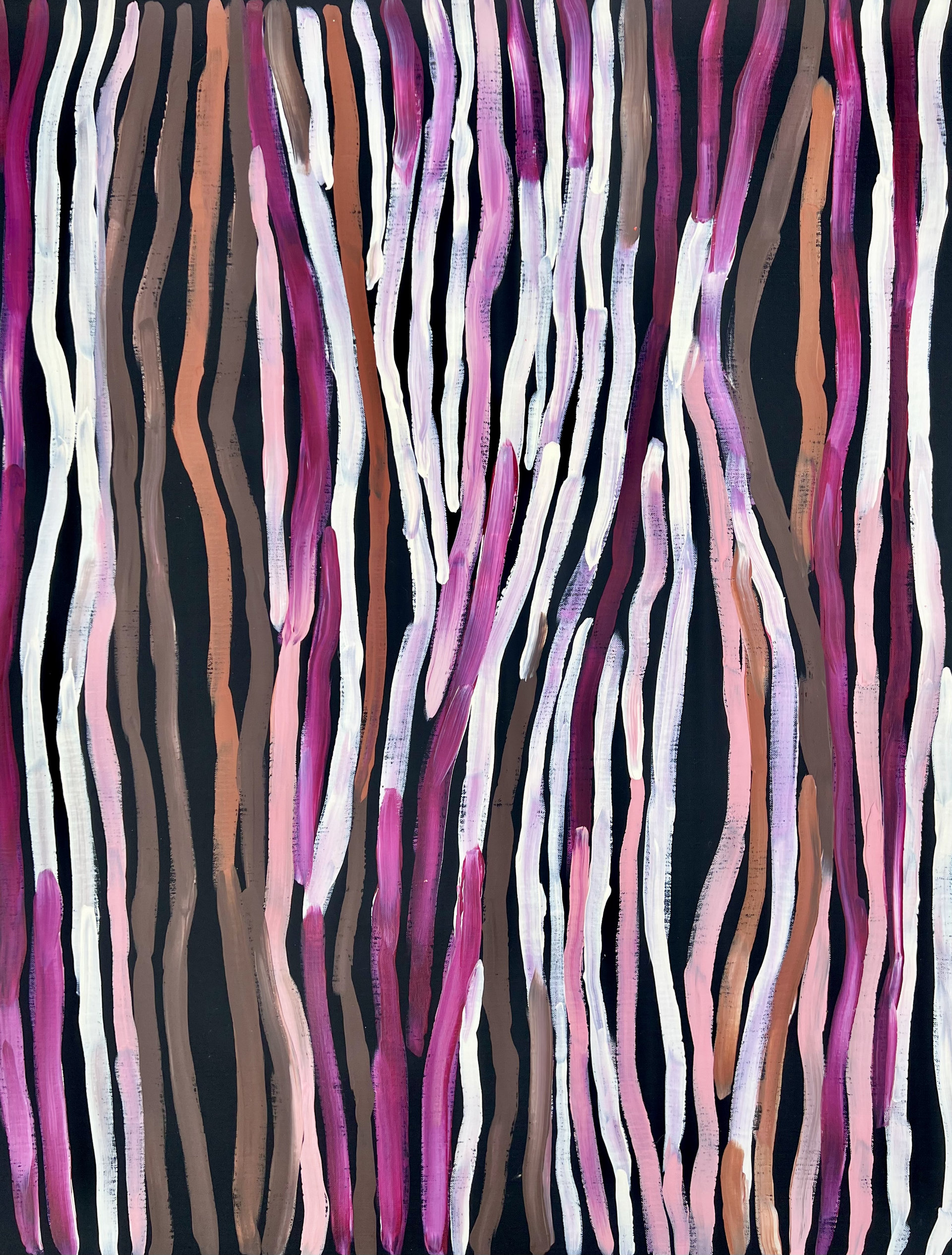
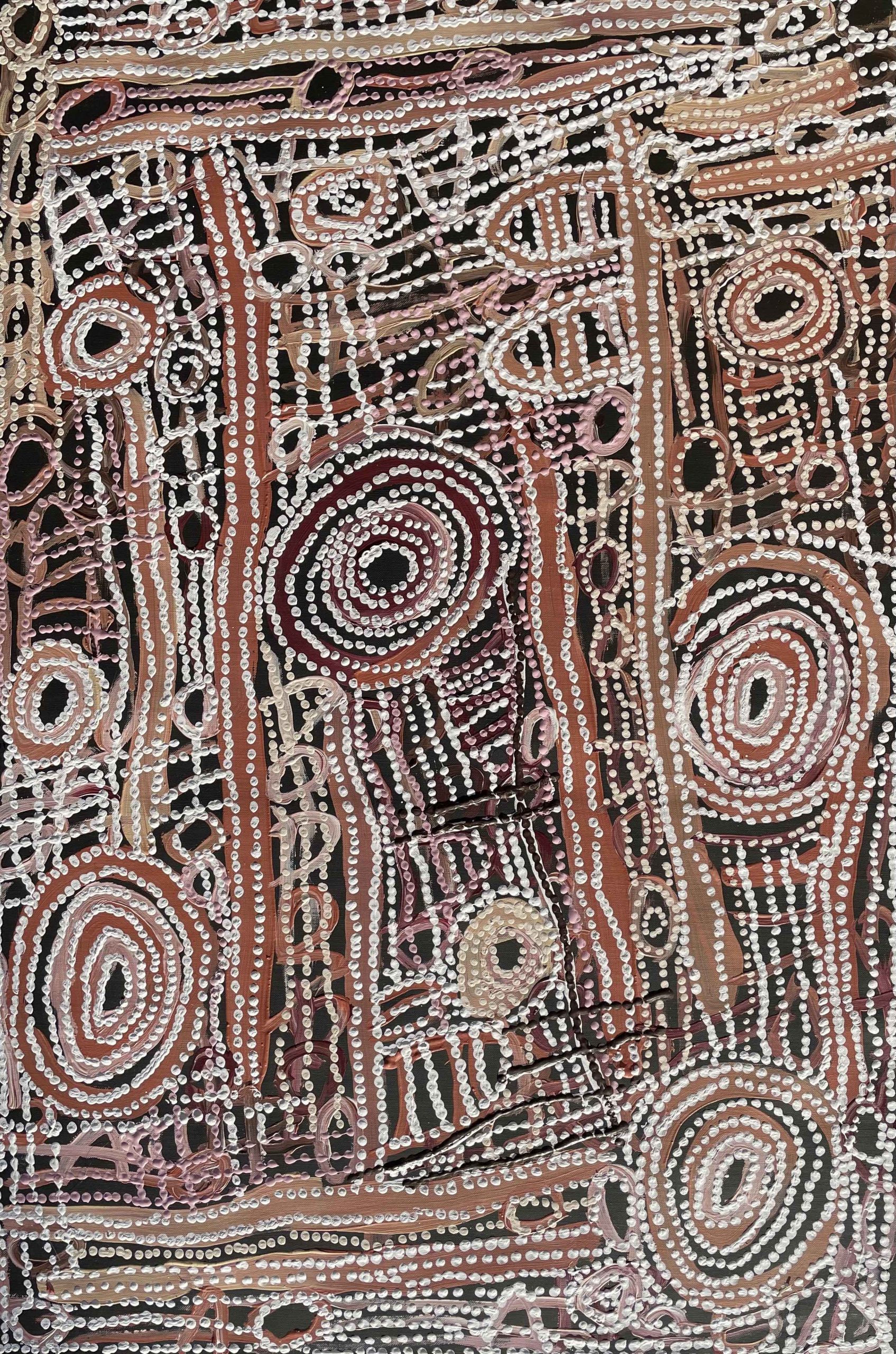
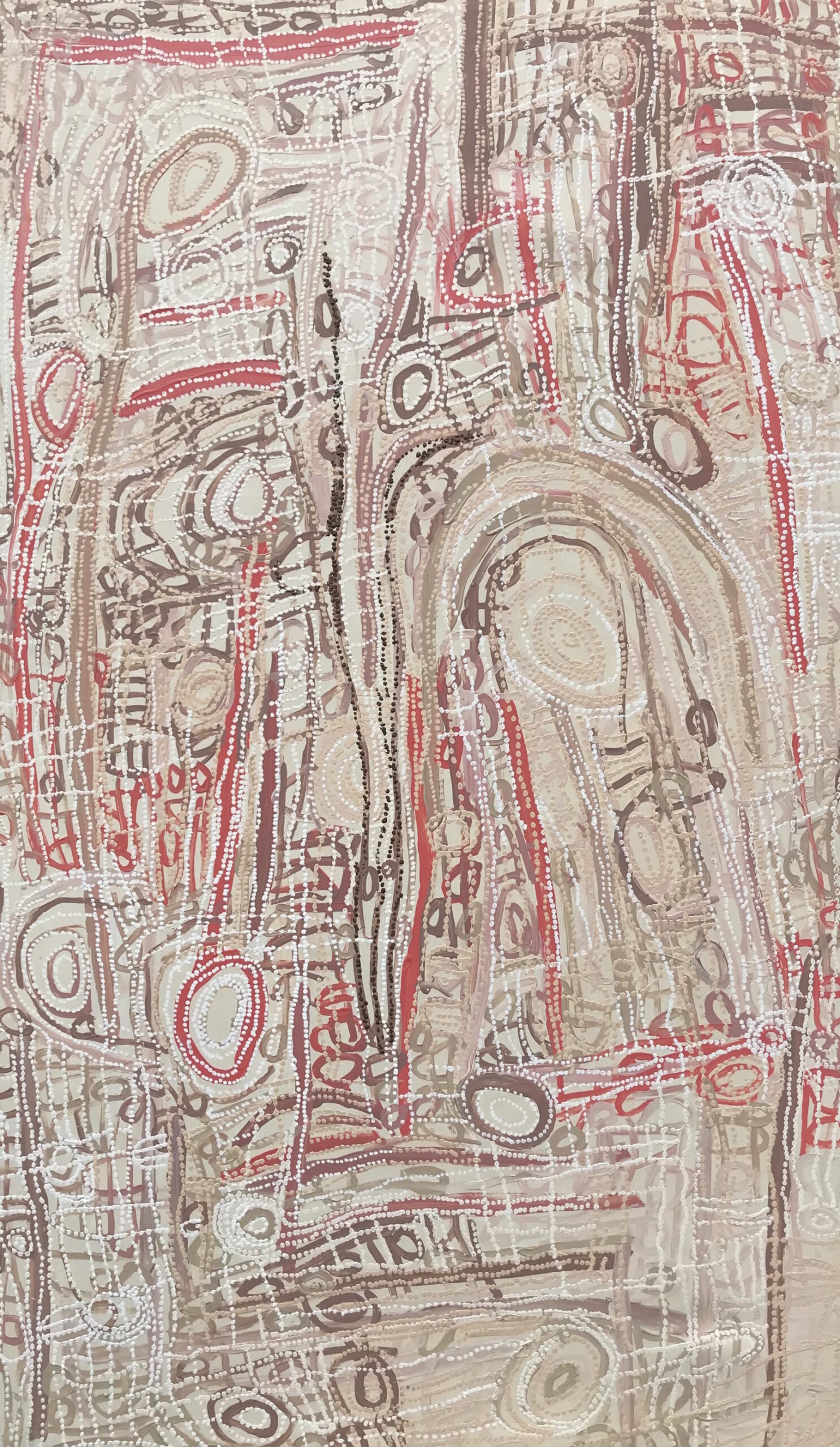
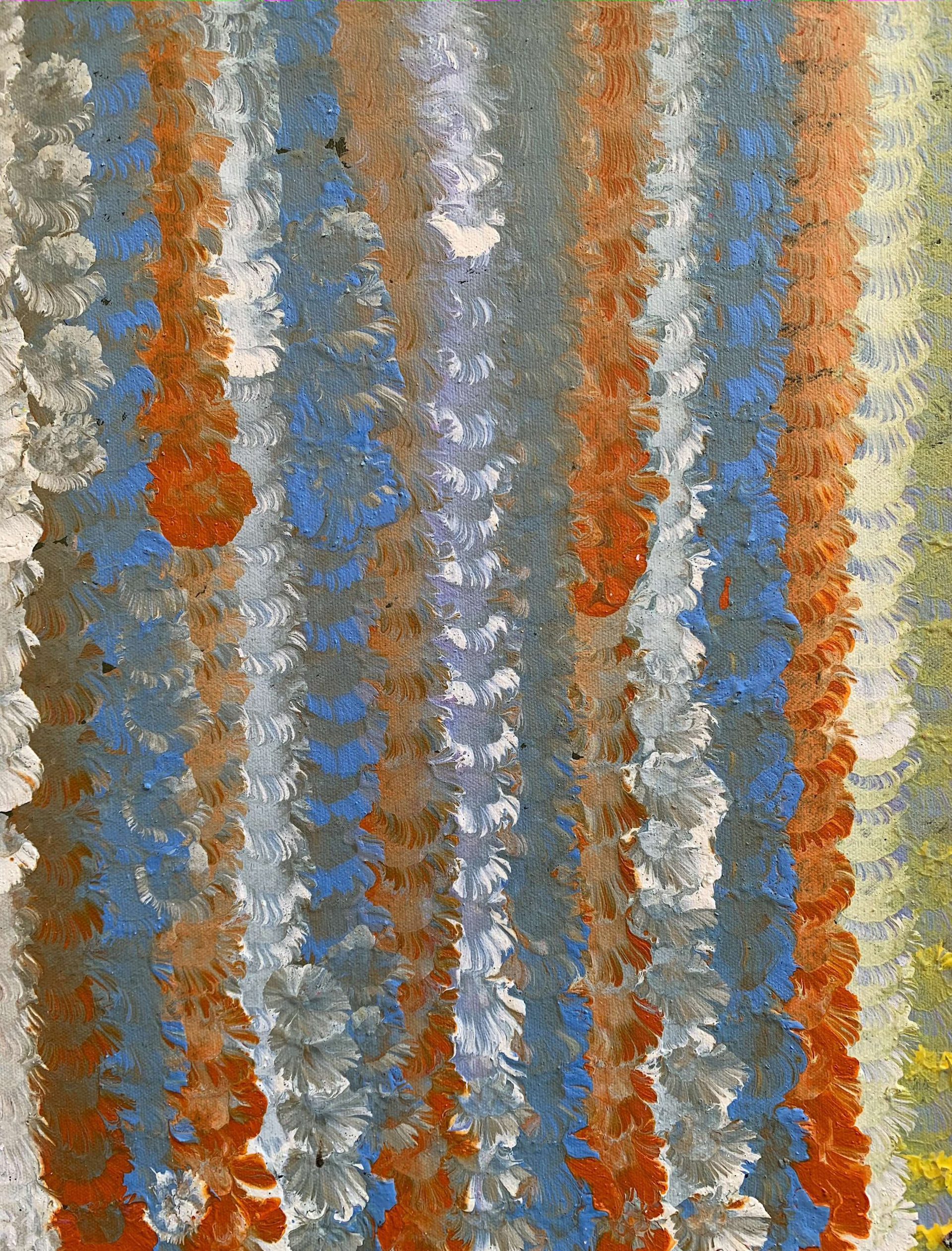
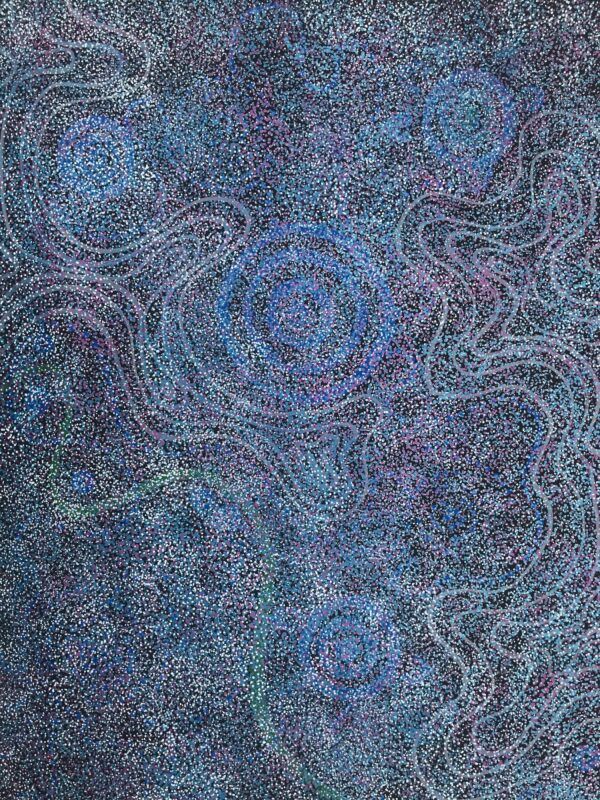
In 1987, Emily was introduced to acrylic paint on canvas as part of the CAAMA Summer Project. She immediately embraced the new medium for its freedom and spontaneity. Her first canvas was exhibited in A Summer Project 1988–89 at the S.H. Ervin Gallery, Sydney, to immediate acclaim. Her technique was highly individual: she often began with drawn forms and then layered them with intricate dotting. When she moved to painting Awelye designs, she developed a new linear style to translate decades of ceremonial gesture, once drawn in ochre on women’s bodies, onto canvas.
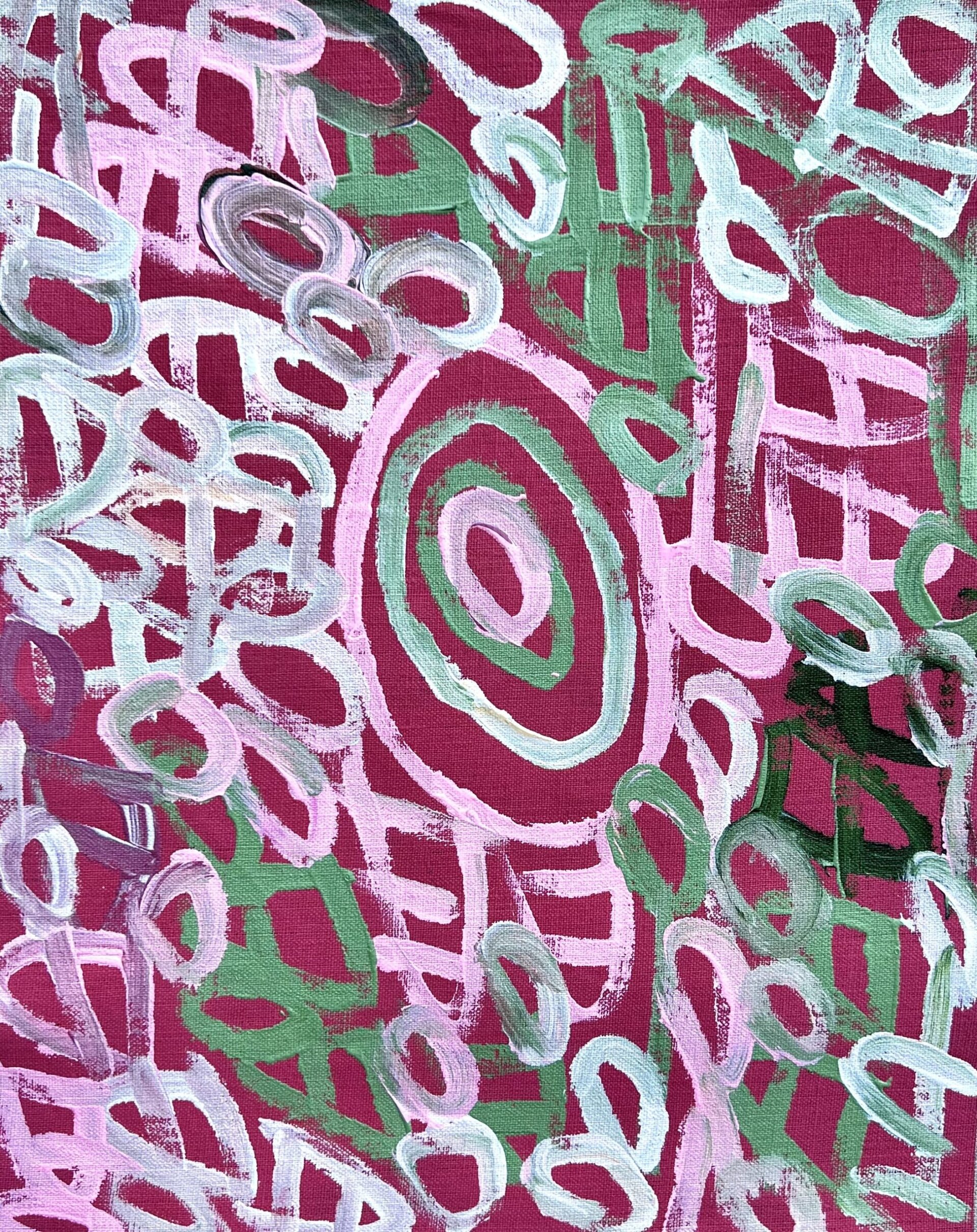
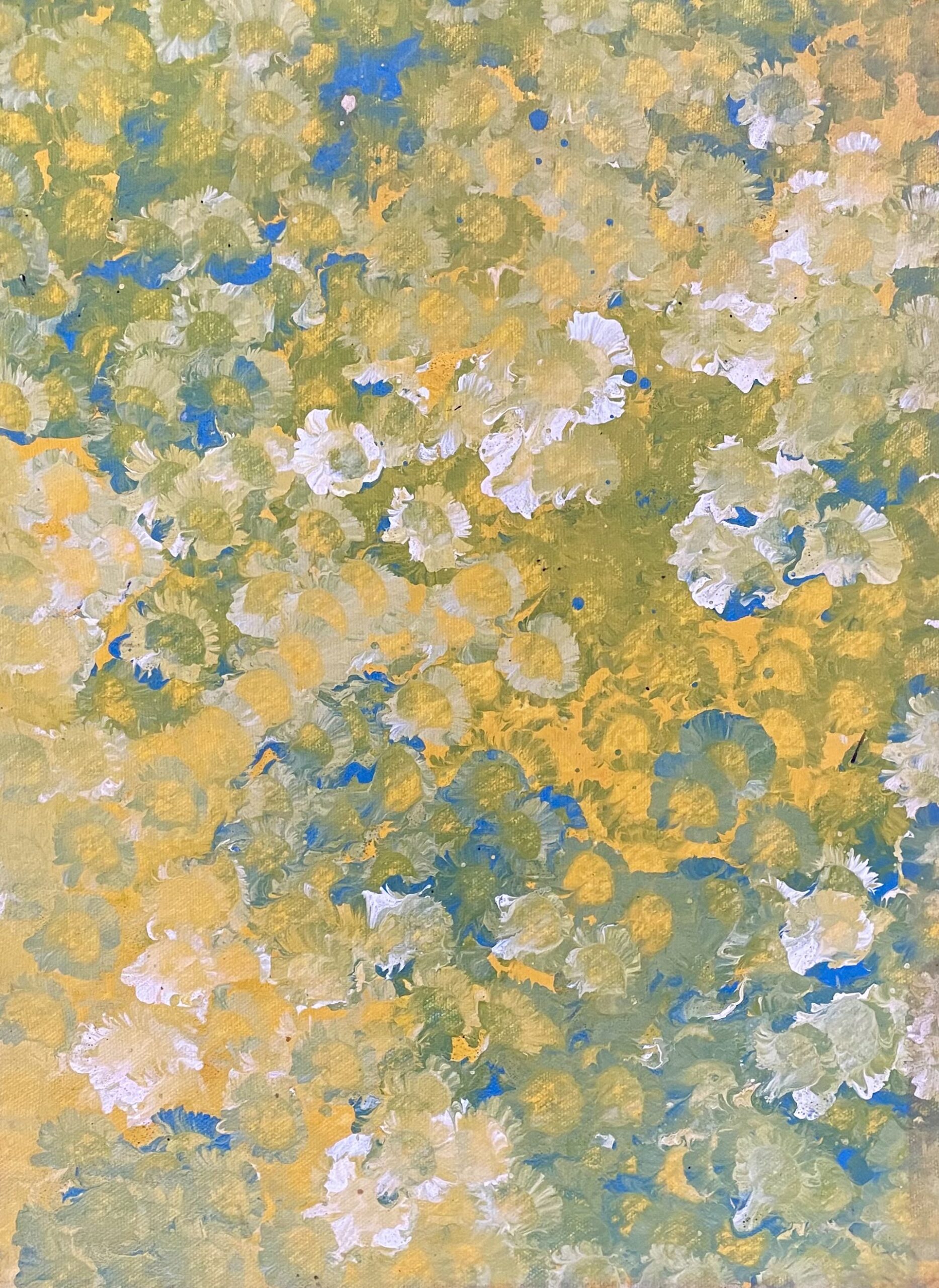
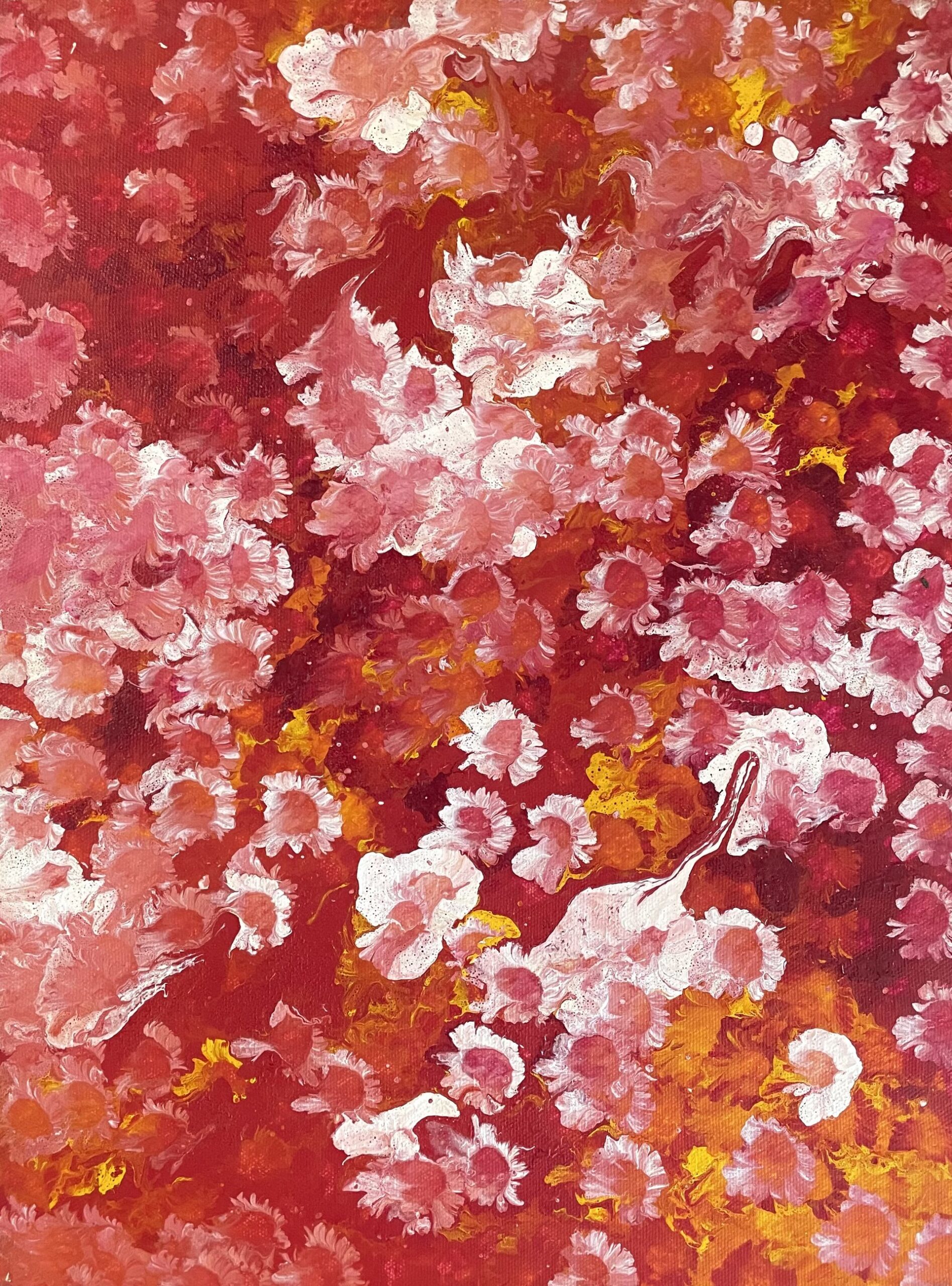
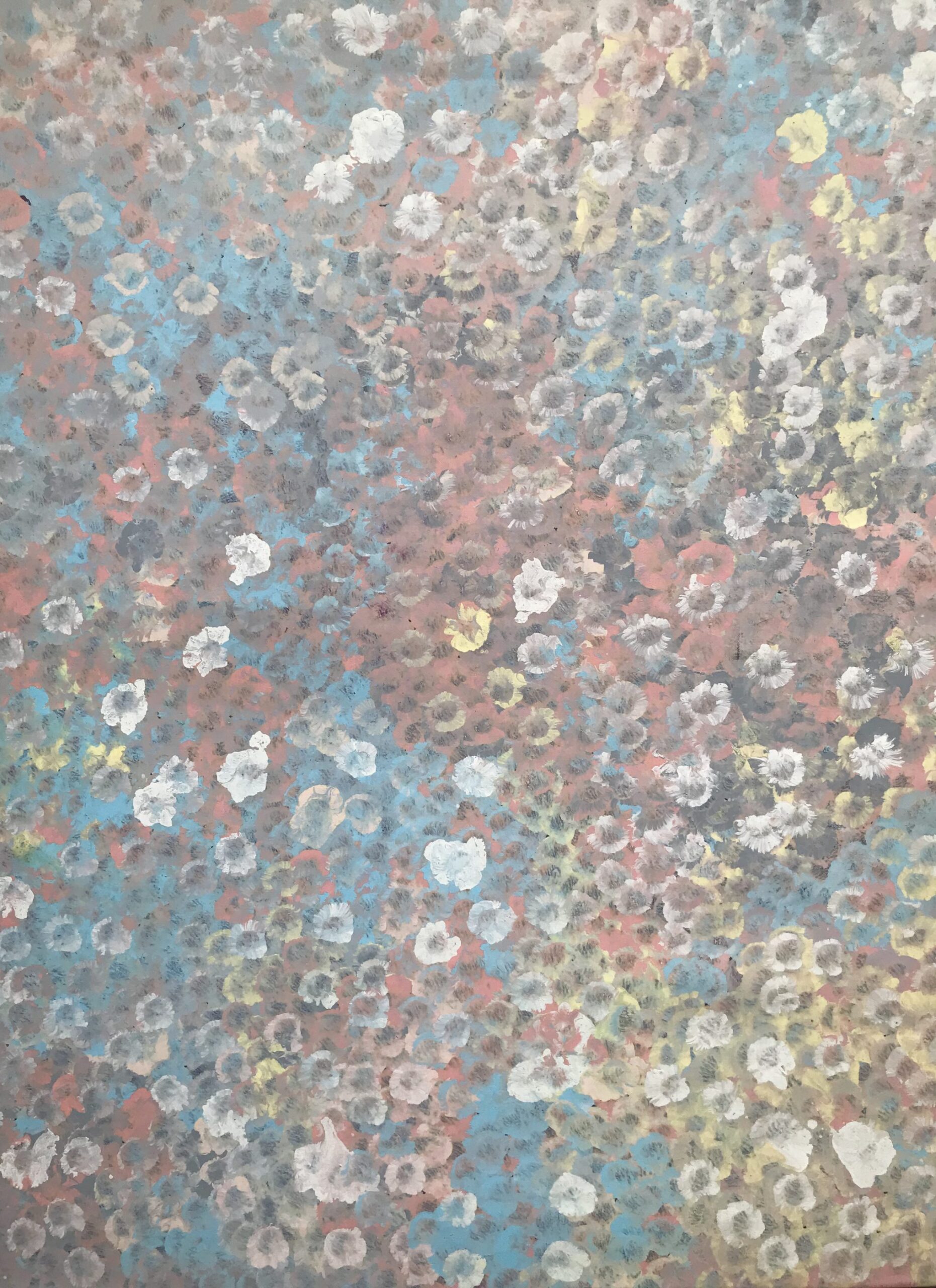
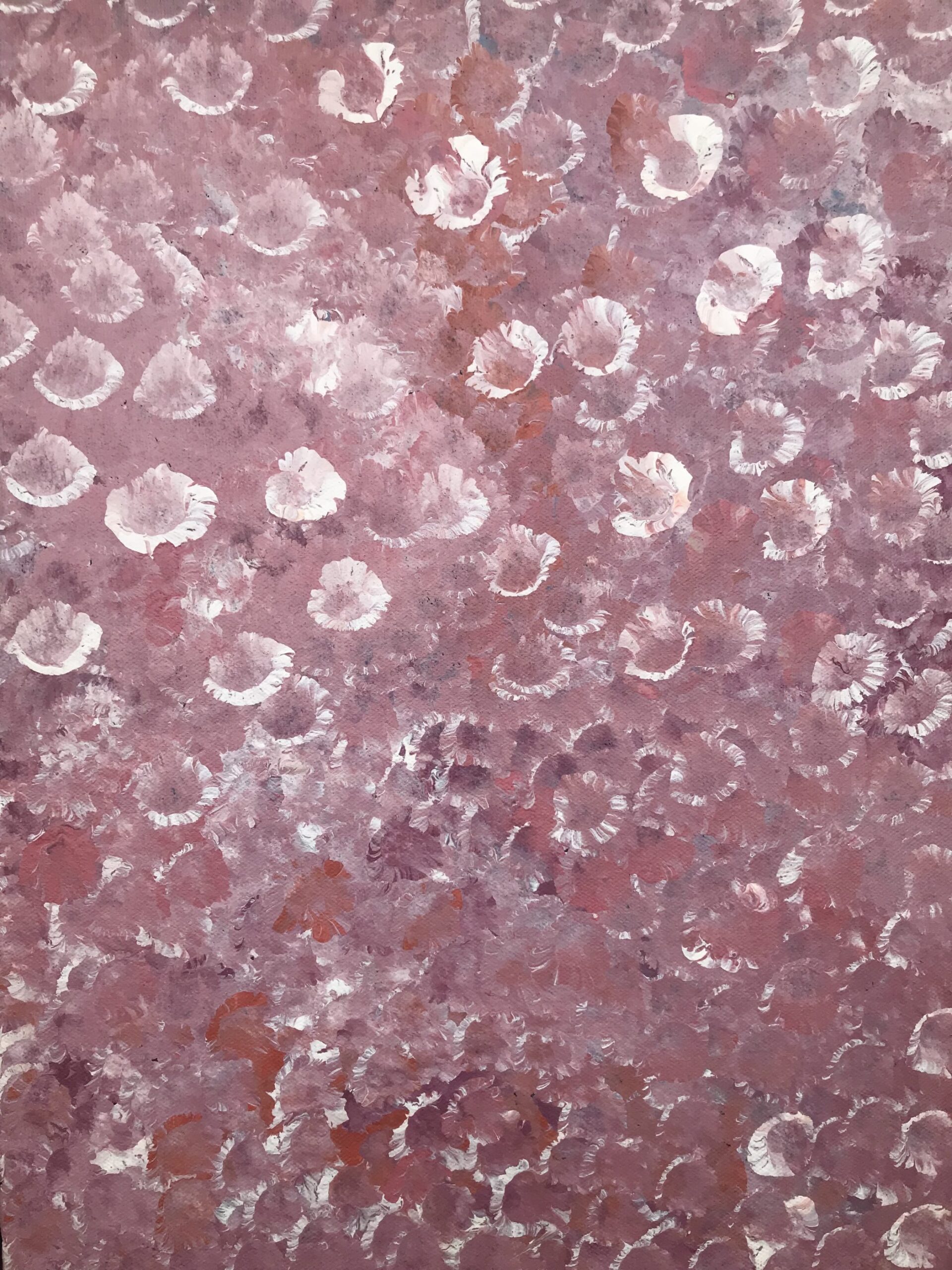
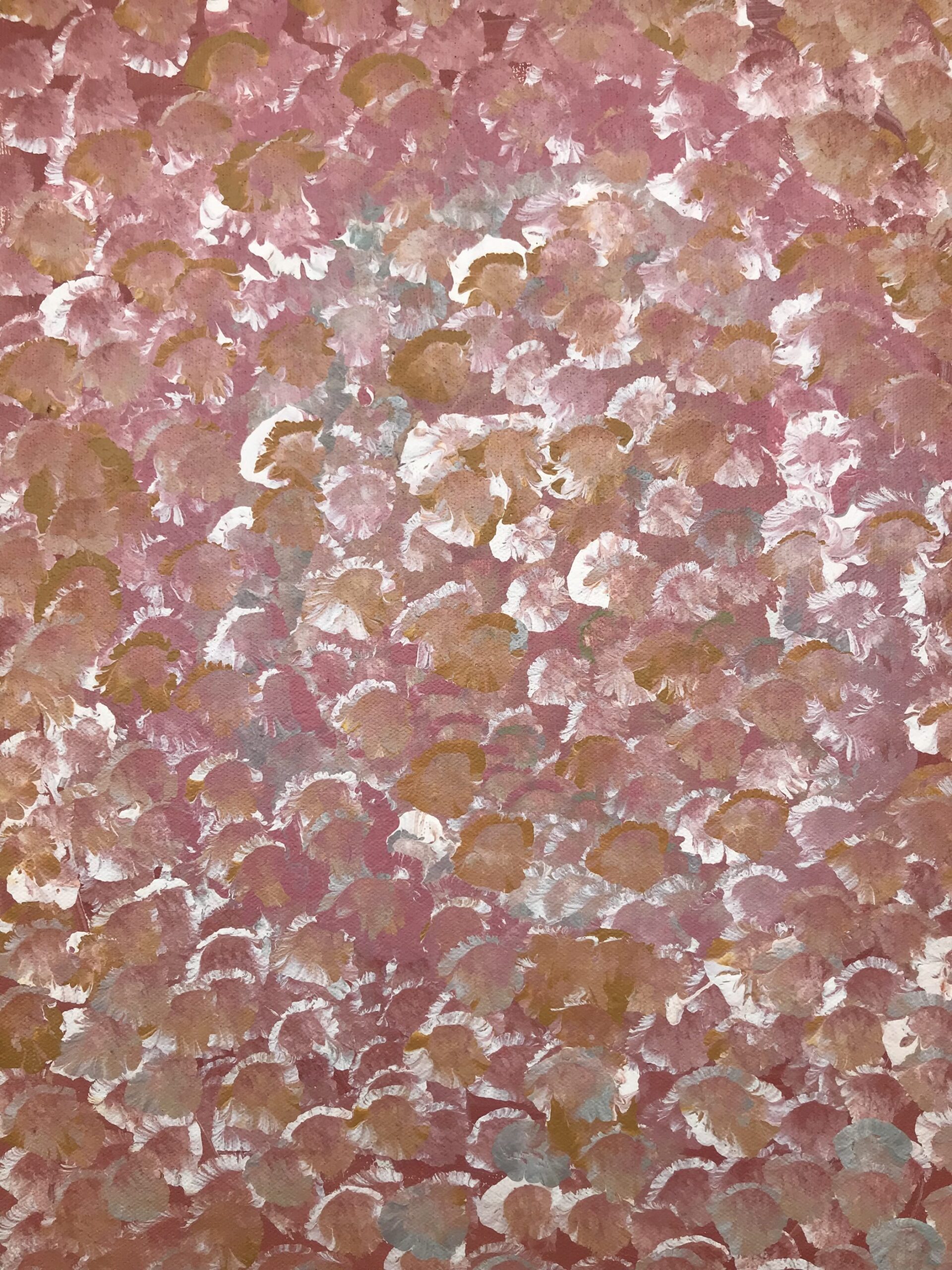
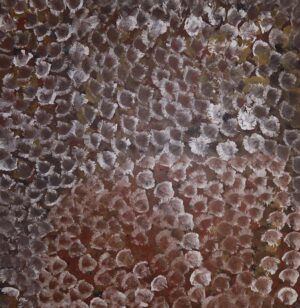
Her love of colour and innovation was evident in her brushwork. Emily would sometimes cut her brushes to create distinctive dot forms, producing canvases that bloomed like fields of wildflowers. Across her career she worked in many styles, but her subject matter remained rooted in her custodianship of Alhalkere.
Emily’s rise was meteoric. In 1990 alone she held two solo exhibitions in Sydney, participated in the Art Gallery of New South Wales’ Abstraction exhibition and joined the CAAMA/Utopia Artists in Residence programme at the Institute of Contemporary Art, Perth. In just three years she participated in 48 group exhibitions in Australia and internationally including in Ireland, Russia, Ukraine, Latvia, Japan and the USA. She represented Australia at the Venice Biennale (1993) and was a key figure in Aratjara: Art of the First Australians (1994–95), the most comprehensive exhibition of Aboriginal art to tour Europe, shown in Düsseldorf, Denmark and London.
In 1992, she was awarded the prestigious Australian Artists’ Creative Fellowship. Her work was featured in the Joan and Peter Clemenger Triennial Exhibition of Contemporary Australian Art at the NGV (1993) and in retrospectives at the Queensland Art Gallery, the Art Gallery of New South Wales and the National Gallery of Victoria (1998–99). International recognition followed with the major 2006–2008 retrospective in Japan, touring the National Museum of Art (Osaka), National Art Centre (Tokyo) and National Museum of Modern Art (Kyoto), attended by over 120,000 visitors.
Her paintings are held in every major Australian state gallery, the National Gallery of Australia, the Vatican Collection, Fondation Opale (Switzerland) and leading Japanese national museums. In 2017, her 1994 masterpiece Earth’s Creation I sold for AUD 2.1 million, a record price at auction for an Australian female artist at the time. Both Earth’s Creation I and Earth’s Creation II are now in the collection of philanthropist Nicola Forrest, securing them as works of national and cultural significance.
DACOU – Port Melbourne, 29 October to 6 December 2009
Retrospective
In 2009, Melbourne became the meeting place for one of the most important cultural events in the history of Utopia art. For six weeks, under the guidance of her family, more than 80 original works by Emily Kame Kngwarreye were brought together in a single space – not as a commercial display, but as an act of honour, truth-telling, and cultural custodianship. This was Emily’s story, told by those who walked with her, worked alongside her, and carried her legacy forward.
In late 2009, DACOU – the Dreaming Art Centre of Utopia – presented a landmark exhibition honouring the life and work of the late Emily Kame Kngwarreye. Emily Kame Kngwarreye: The Person and Her Paintings was the most comprehensive family-curated exhibition of Emily’s work since her passing in 1996, bringing together more than 80 original paintings across her major series.
Curated under the cultural authority of Emily’s family, the exhibition offered an unprecedented opportunity to experience the full breadth of her artistic journey. Works spanned from her early finely dotted canvases to her expansive late-career brushwork, tracing her evolution as one of Australia’s most significant contemporary artists. Visitors could stand before paintings that carried the energy of Alhalkere, her ancestral country in the Utopia region, and witness the way her style transformed while her subject matter – the Yam Dreaming – remained constant.
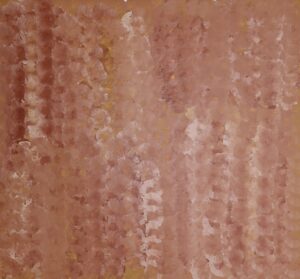
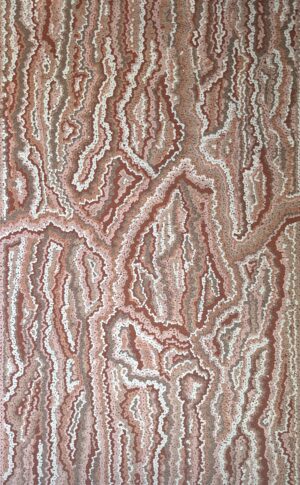
A major highlight was the inclusion of several works from Emily’s Ochre Series, painted with natural ochres and charcoal sourced directly from her Country. These works carried a deep ceremonial resonance, physically bringing the materials of Alhalkere into the gallery space. The exhibition also featured the monumental four-panel Earth’s Creation (1994) – considered a sister painting to the record-breaking Earth’s Creation I. Its sheer scale and intensity conveyed the seasonal vitality of her country after the rains, when the desert floor bursts into colour.
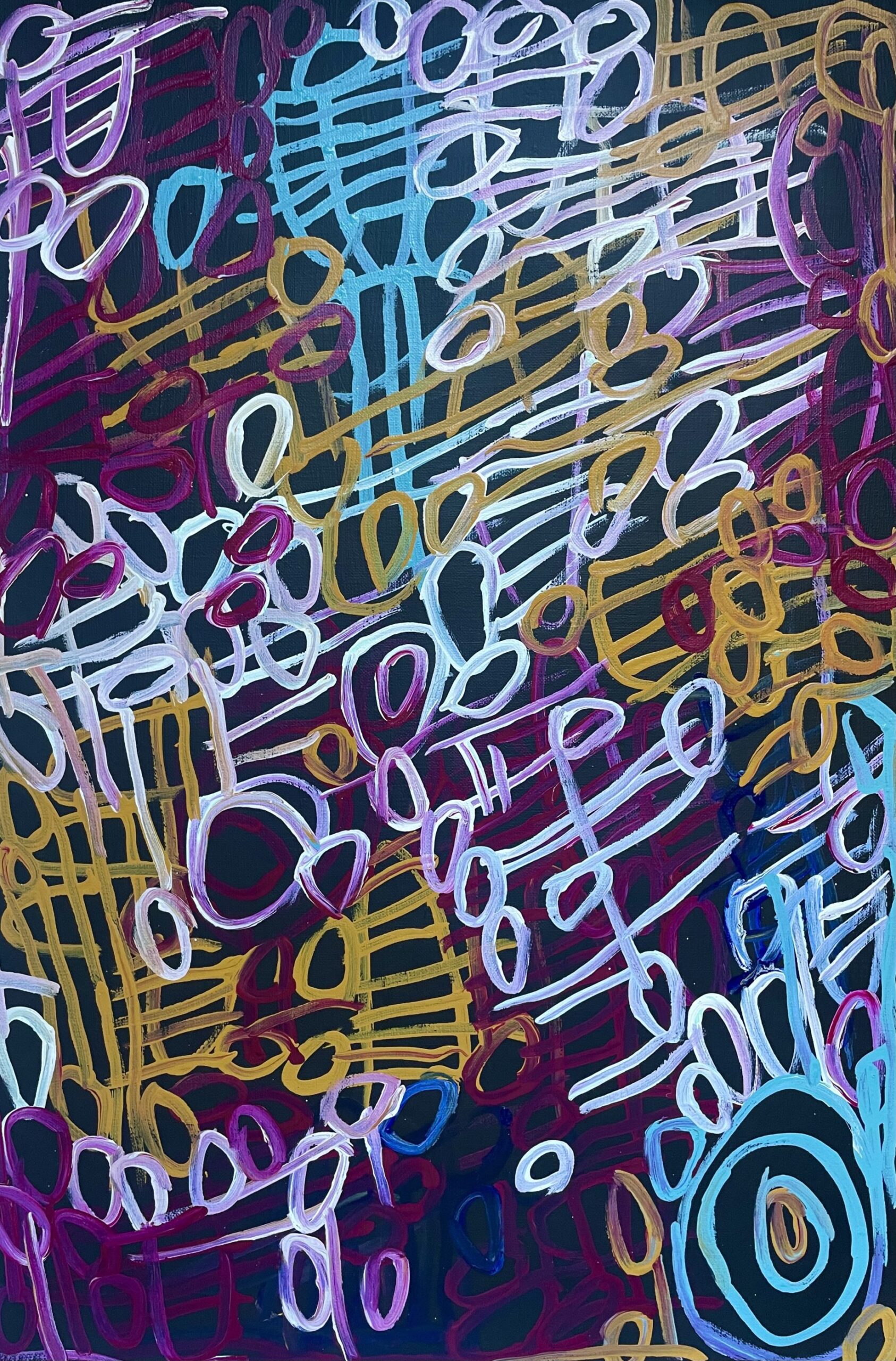
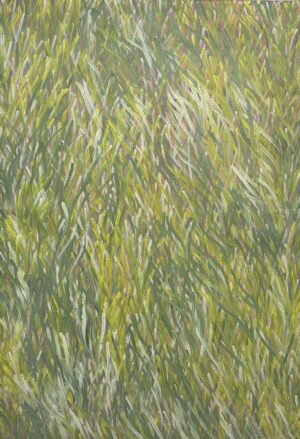
Other significant series represented included My Country and Wildflower, each revealing different facets of Emily’s creative language – from intricate dot fields mapping her Dreaming stories to sweeping gestural marks that embodied the rhythm of the land and ceremonial movement.
The exhibition was accompanied by a substantial 235-page illustrated catalogue, edited by Anne Runhardt with research and essays by Dr Victoria King. This remains one of the most detailed resources on Emily’s work ever produced, enriched by family narratives and historical context from Utopia, providing rare insight into her life, artistic practice, and role as a senior Anmatyerre Law woman.
Emily Kame Kngwarreye: The Person and Her Paintings was more than an exhibition – it was a family-led act of custodianship, ensuring her story was told with accuracy, respect, and cultural integrity. Collectors, curators, and art lovers travelled to Port Melbourne to view works, many of which had never been exhibited before and have since entered significant private and institutional collections. The show reaffirmed Emily’s standing not only as a pioneering Aboriginal artist, but as a creative force whose vision resonates globally.
The exhibition was also a major cultural gathering. It was attended by John Moorse AM, then Director of Tourism, and Dr. Margo Neale, senior Indigenous art curator and historian. Most notably, members of the Utopia community travelled from Alice Springs to be present, including renowned artists Barbara Weir and Gloria Petyarre. Their attendance underscored the deep familial and cultural ties that shaped Emily’s life and art, and affirmed the event as both an artistic and community milestone.
Reflecting on the show, art critic Dr Marcus Bunyan offered this powerful insight in his review for Art Blart (29 November 2009): “Rarely do I have such an emotional reaction to art. When it does happen, it washes over me, it cleanses my soul and releases pent-up emotions; about life, about mortality... On this day I saw. I felt.”
This sentiment captured the atmosphere of the exhibition perfectly – a moment where art, culture, and community converged to honour one of the most important artists in Australia’s history, as told by those who knew her best.
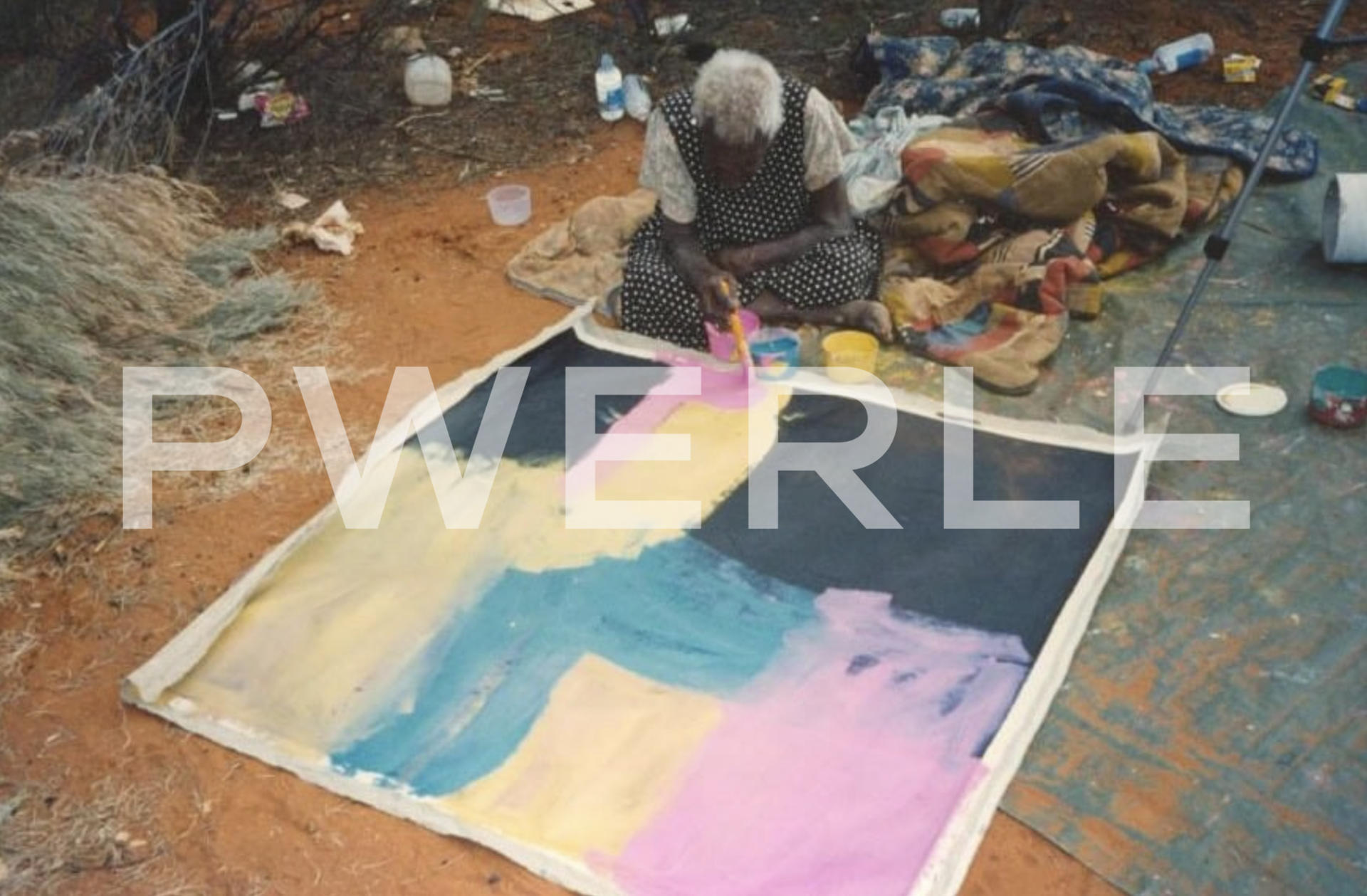
During the eight years of her remarkable career and meteoric rise to fame as Australia’s most celebrated female artist, the late Emily Kame Kngwarreye painted over 3,000 canvases. Each was a celebration of her country, Alhalkere, her Yam Dreaming, and the women’s ceremonial Awelye body painting designs for the Atnwelarr yam. In August 1996, in her mid to late eighties and in fragile health, Emily summoned her great-nephew in Aboriginal Law, Fred Torres — Director of DACOU — to Utopia because she wanted to paint. Despite Fred’s reluctance to let her risk her health further, Emily’s authority and determination, as always, prevailed.
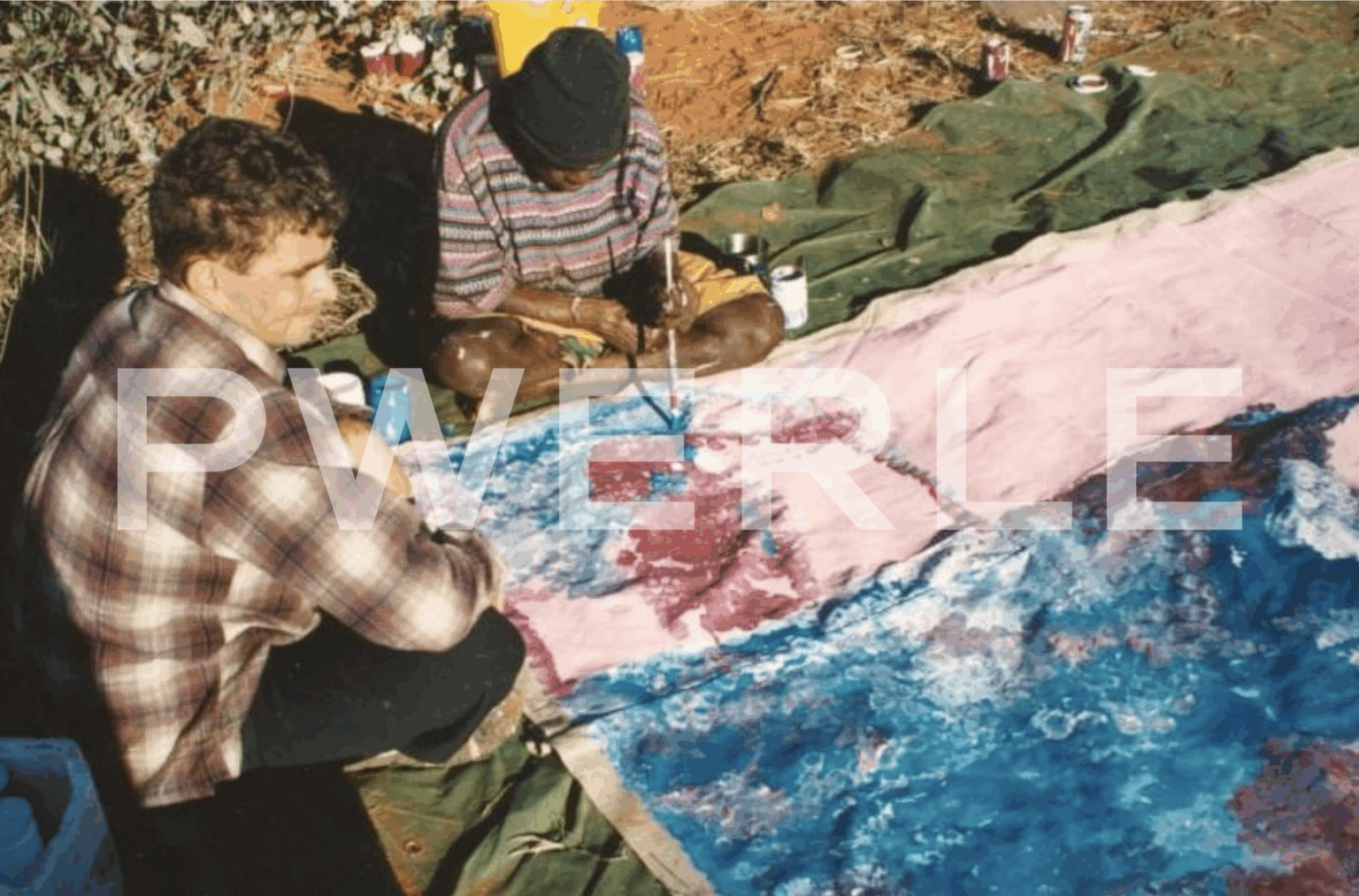
At a bush camp, sitting cross-legged on the ground, she asked for canvas and acrylic paints. Fred began unrolling the canvas and preparing jars of paint, only to realise he had brought none of her usual brushes — just a very broad gesso brush normally used for undercoating. While Fred considered what to do, Emily simply picked up the gesso brush and painted a vast, single-coloured area across the canvas in front of her. Without pause, she dipped the brush into a different colour and swept another broad section across the surface. In no time the first small canvas was complete — and with the gesso brush still dripping paint, Emily was ordering Fred to bring her another.
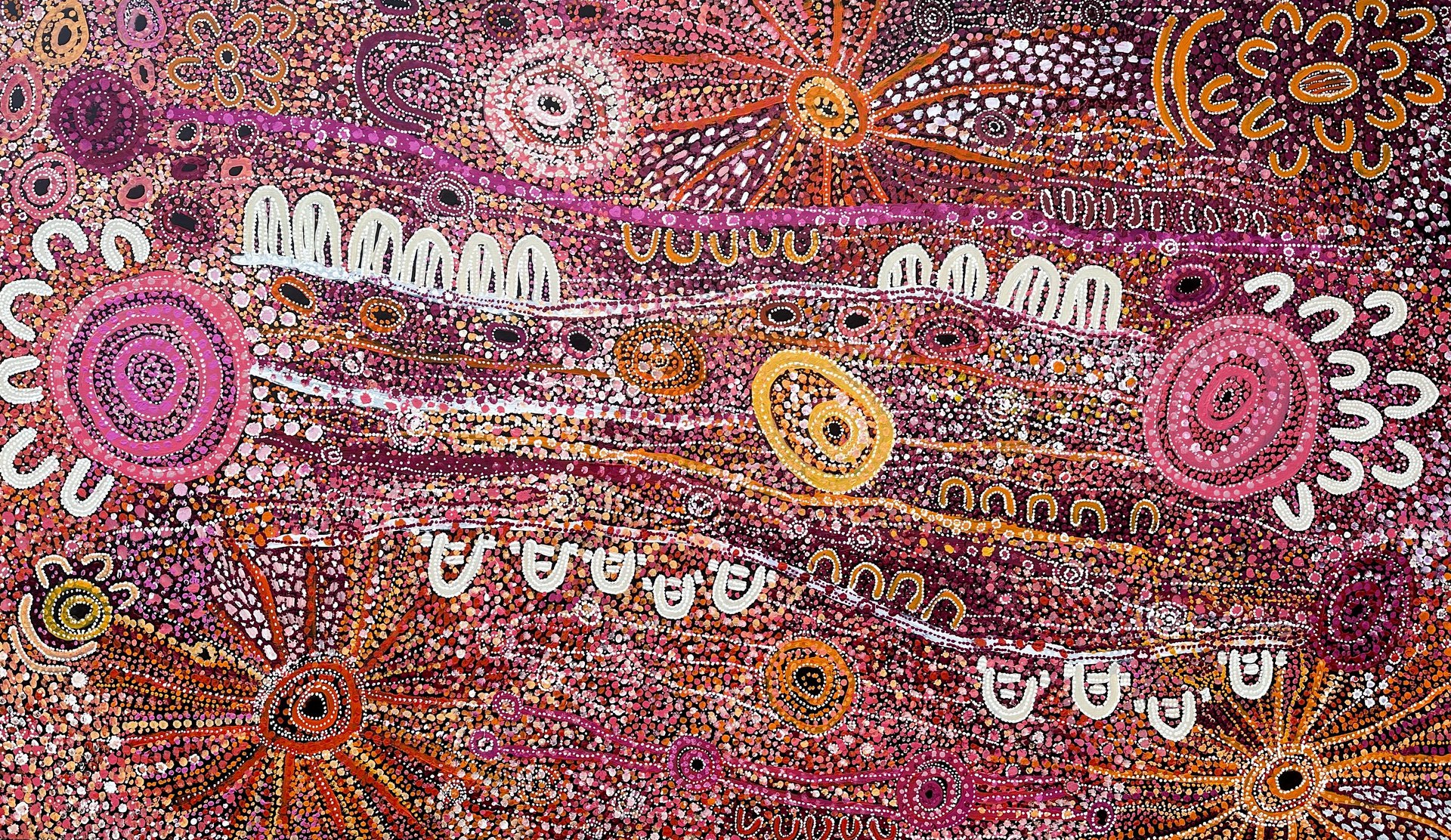
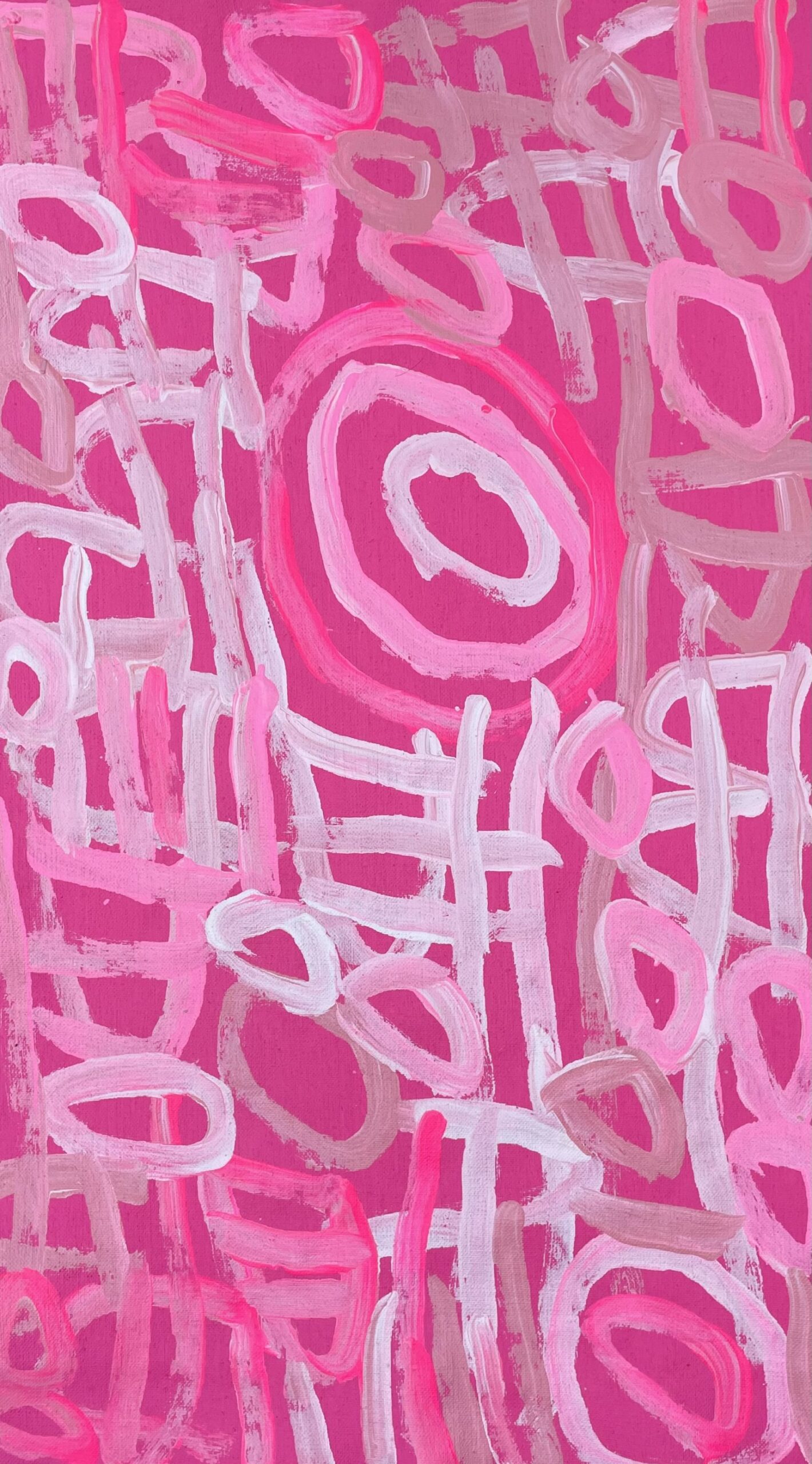
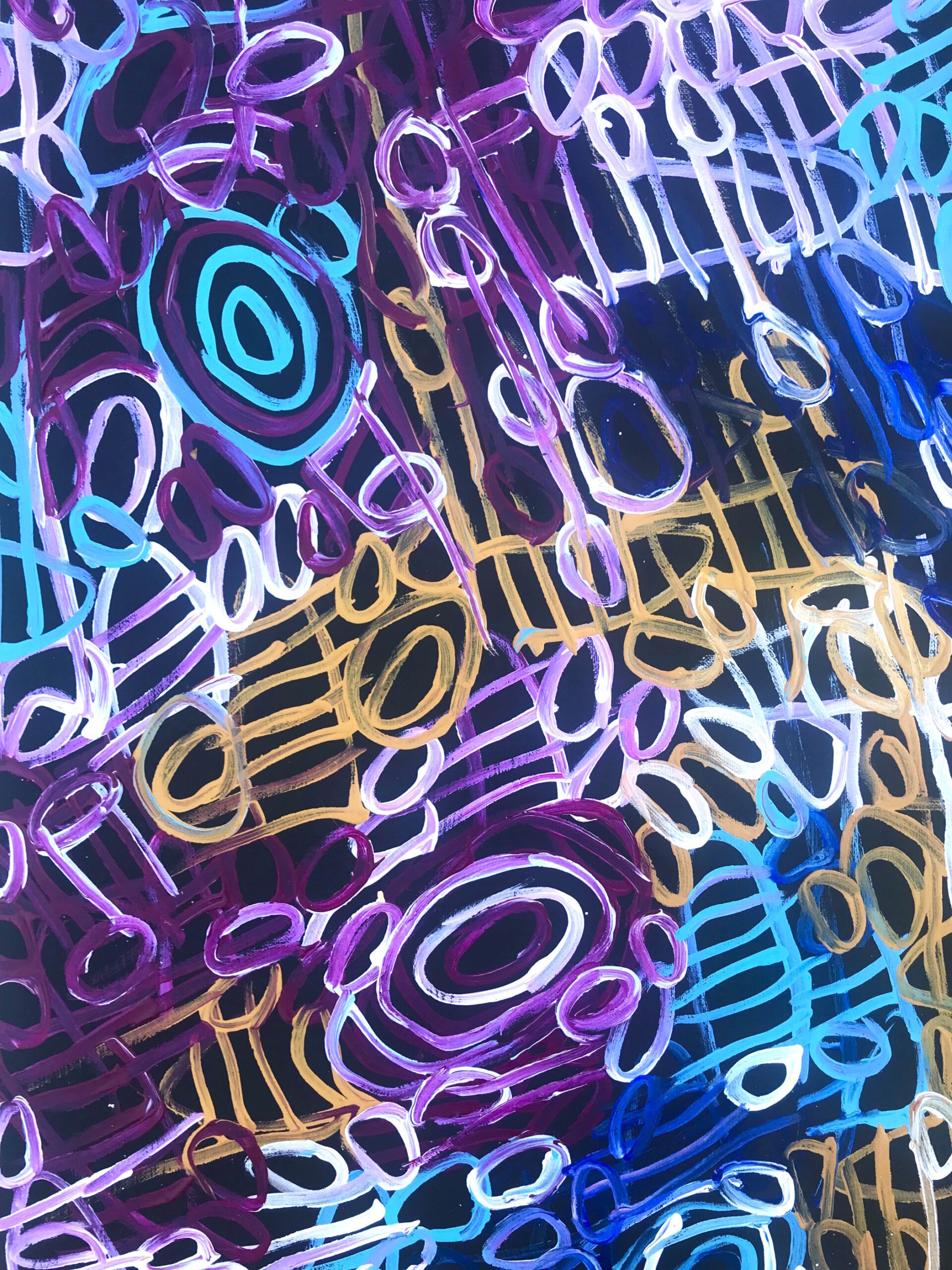
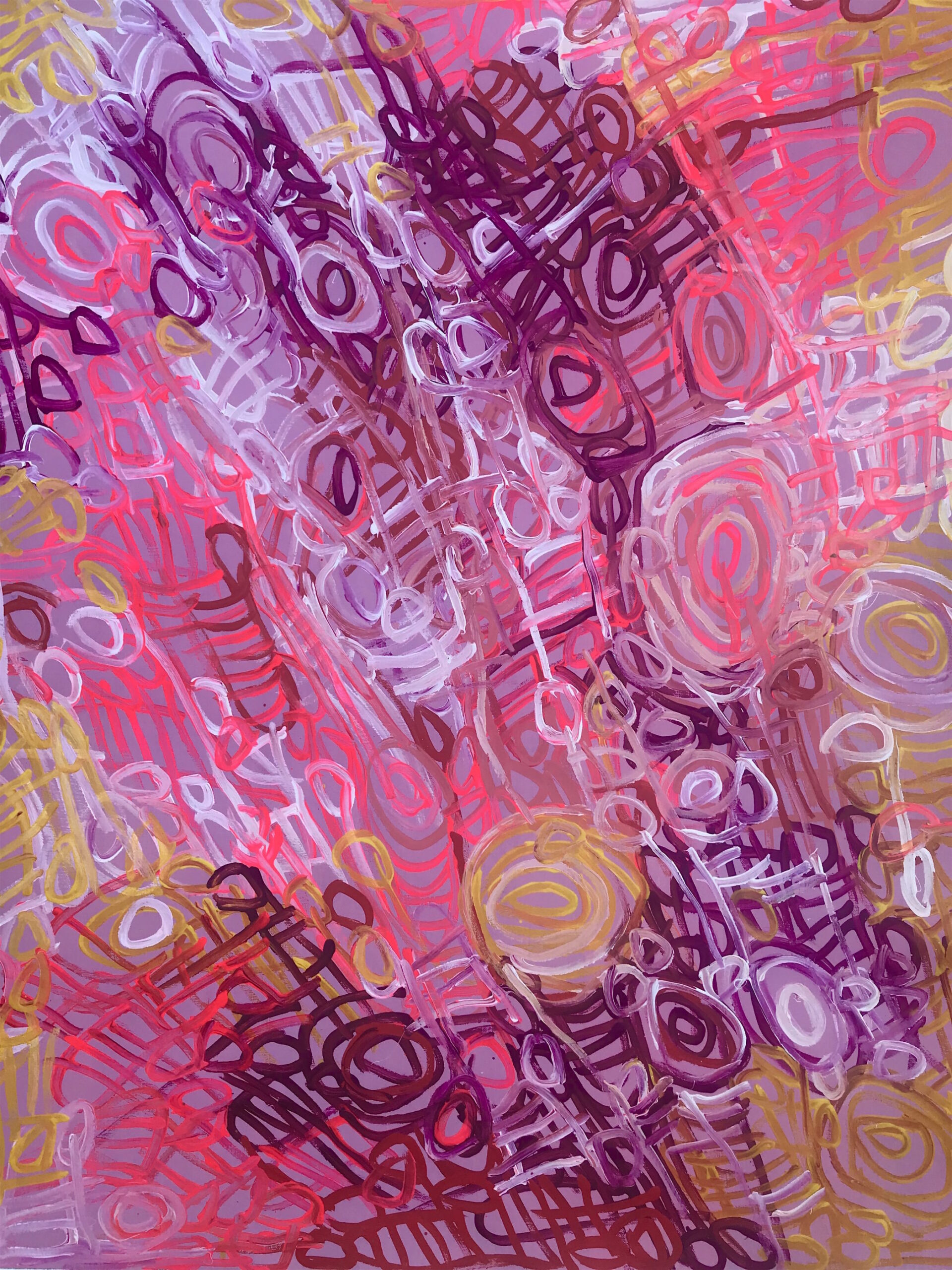
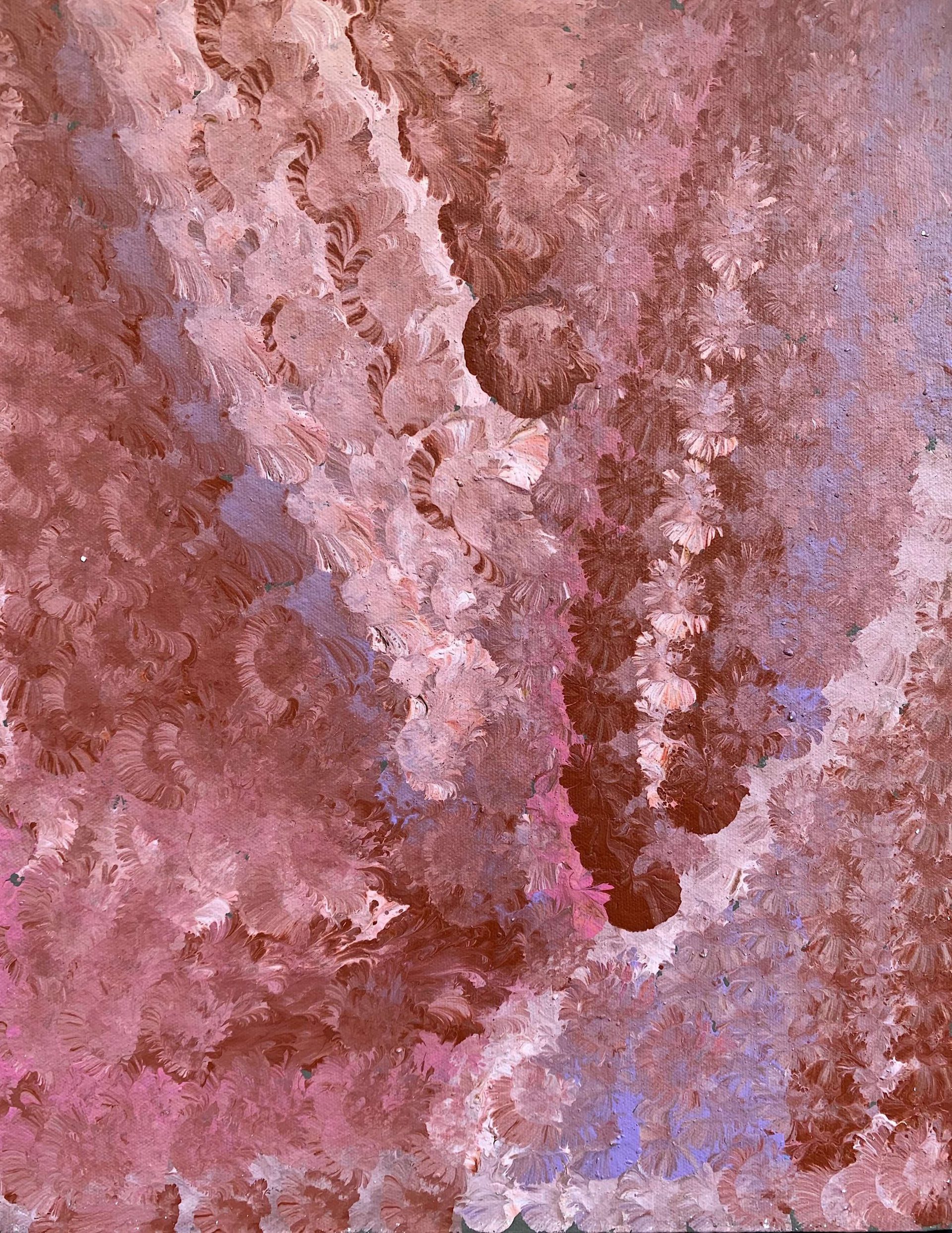
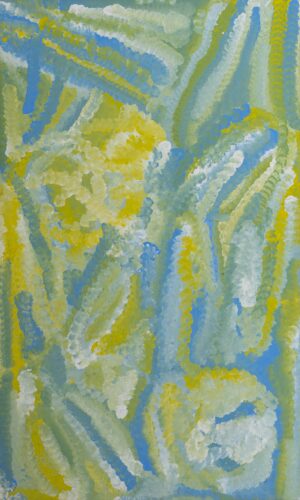
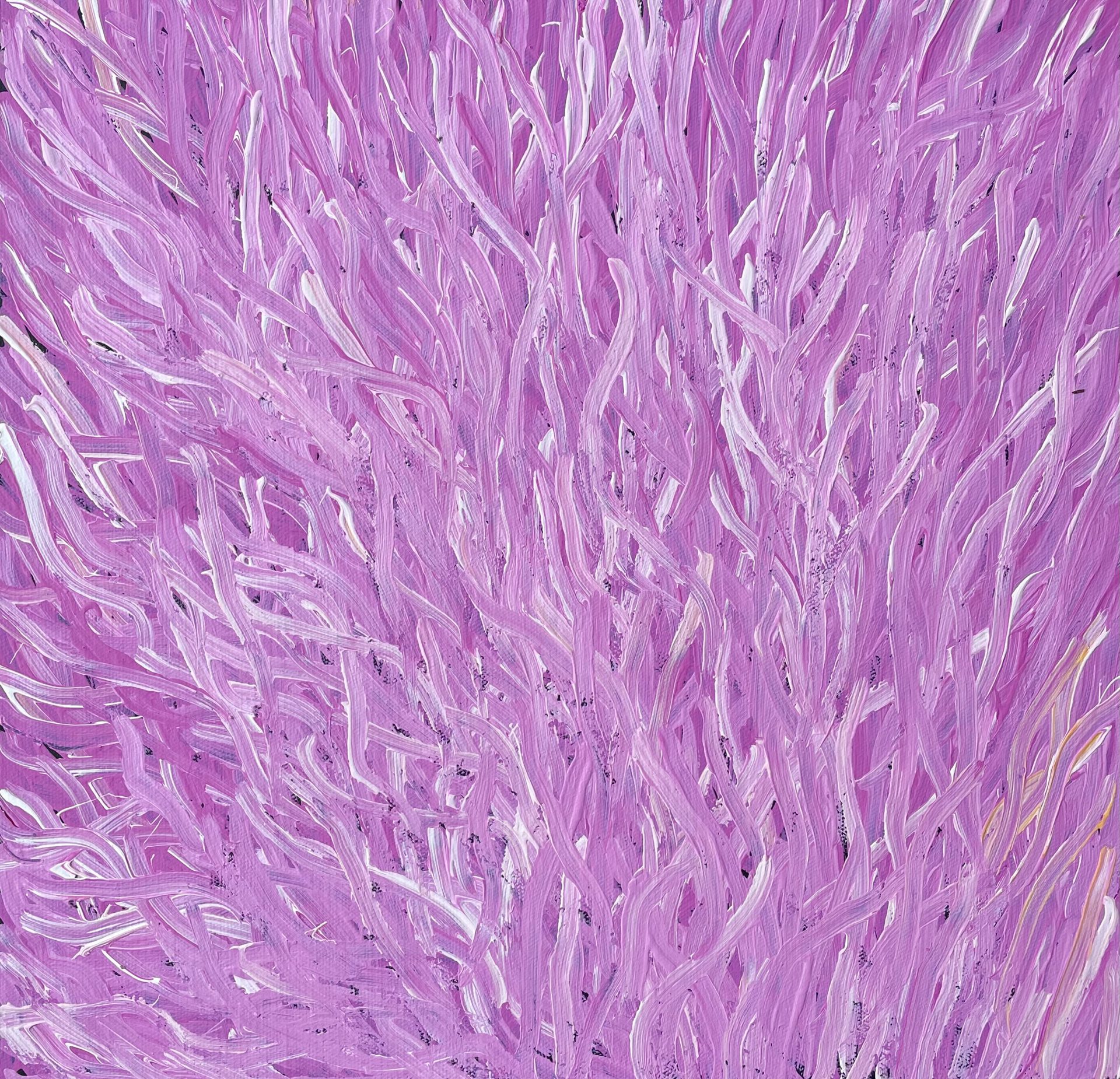
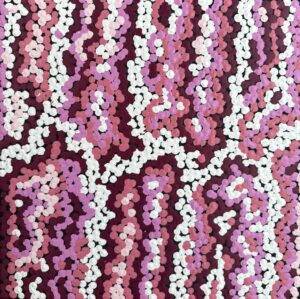
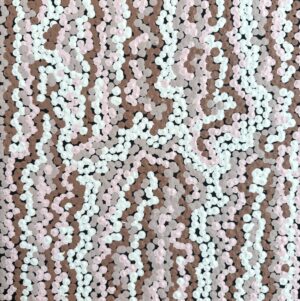
Over the following days, Emily painted twenty-three more canvases in this way. These works were unlike anything she had produced before: broad, confident sweeps of paint creating fields of light, space, and exuberant colour, dispensing entirely with dots and lines. She worked in crimsons, scarlets, rich purple-mauves, and red-browns — high-key variations of the red sandy earth of Alhalkere — and in delicate pastel whites echoing her namesake kame (yam seed). The yam’s yellow flowers shone in lemon and cadmium tones, while the ceremonial red ochres she once painted on women’s bodies for Awelye found their acrylic equivalents in bright pinks and orange-reds.
Fred quickly realised he was witnessing another transformation in Emily’s creative journey and documented each painting. Even more astonishing was the burst of energy these works seemed to bring her — alongside the twenty-four Final Series paintings, she also produced several new Yam Dreaming and Awelye works. Back in Adelaide, Fred unrolled the canvases at DACOU. Those who first saw them were spellbound by the radiance of their colour. From the very beginning, Fred knew they would be considered among her most important and discussed works.
Emily died in Alice Springs on 2 September 1996. As the art world and her community grieved, it became clear that this senior Anmatyerre Law woman had made an indelible mark on Australian art. It was only fitting that a major curated retrospective of her work be shown in each of the prestigious Australian state galleries, beginning with the Queensland Art Gallery. Five paintings from the Final Series were chosen as a tribute to her creativity in the final days of her life.
Judith Ryan, Senior Research Curator of Australian Art at the National Gallery of Victoria, wrote of these works:
“Having exhausted all possible use of multiple round or long marks, Kngwarreye eliminated them altogether, expanding her brush marks into broad blocks of tone and colour until she re-invented herself.”
Christopher Hodges of Utopia Art paid his own tribute: “Kngwarreye at this late stage took a new tack and created, with barely one coat of paint, fields of colour that are beguiling in their simplicity. The sureness of these paintings is absolute.”
As Emily painted her Final Series, she often gestured to the land around her, saying “Alhalkere” — the name of her country for which she was custodian. Her connection to Alhalkere was total and profound. With painterly economy, she conveyed its essence with a sense of spaciousness and light that feels almost spiritual. These works can be read as a final merging of self and Country — a dissolution of form, a last gift.
The echoes of Emily softly singing the songs of Alhalkere can still be felt in her paintings today. Her life continues to inspire generations of Indigenous artists, not only in Utopia but across Australia. Her art bridges cultures, delights audiences worldwide, and offers a glimpse into a more connected and grounded way of being on this earth.
Earth’s Creation
Dr. Victoria King - written for DACOU Gallery.
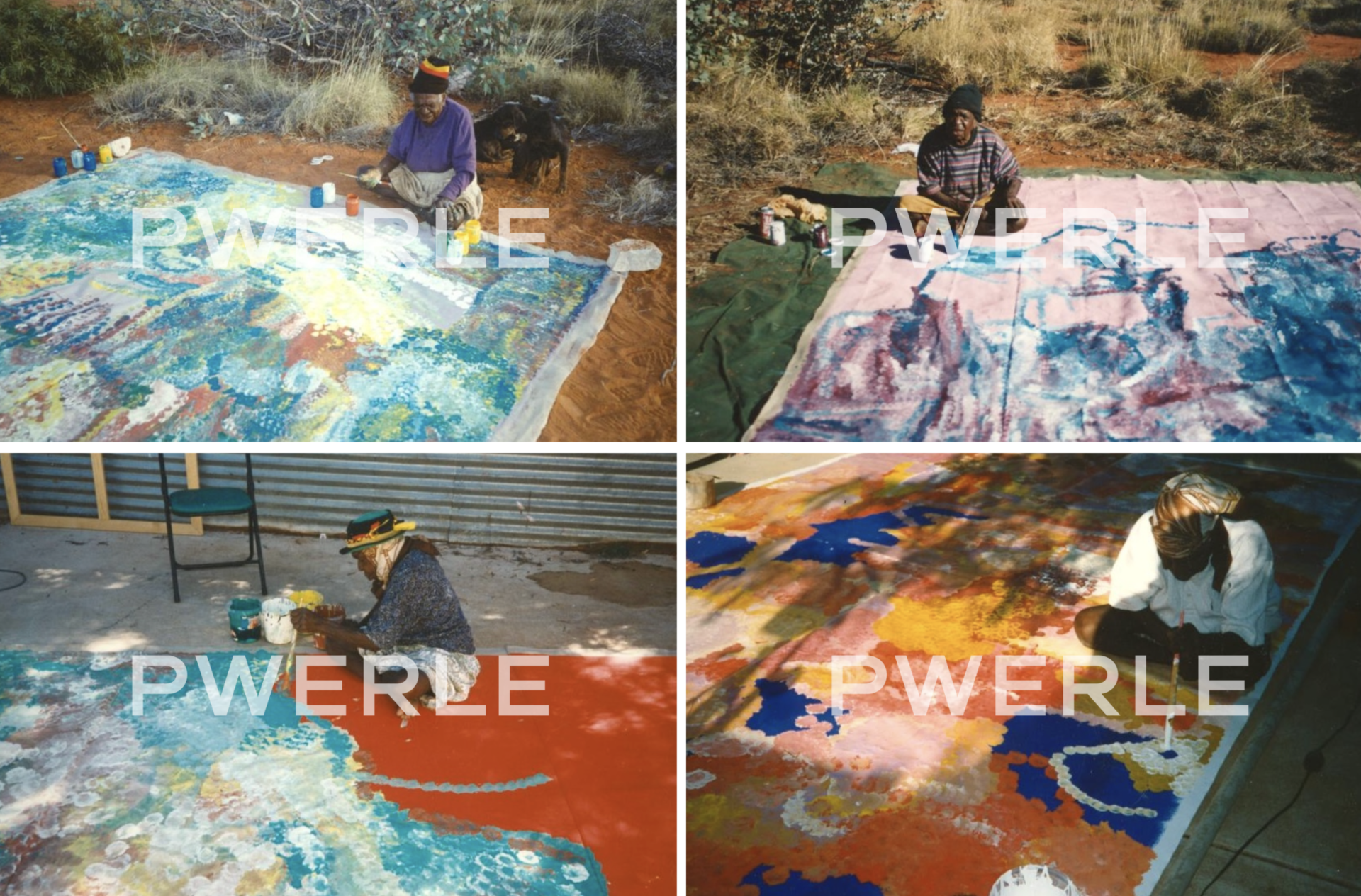
Before Emily Kame Kngwarreye would begin to paint, she and other family members would go out hunting at Utopia and look for a suitable place in the bush to make a camp for her to work. This was always a time of great happiness and expectation. Wood was collected for a fire to cook on, painting materials would be prepared and Emily would talk about her country of Alhalkere. Her great love for her country and her custodianship for it were the subject of “Earth’s Creation”.
Emily in fact painted four major artworks in 1994 at Utopia entitled ‘Earth’s Creation’, all commissioned by Fred Torres. The first sold for $1.056 million at a 2007 Deutscher-Menzies auction, breaking all previous records for an Australian female artist and is now the signature piece of the Tim Jennings collection, a comprehensive collection of mainly Utopia art, open for the public at their Alice Springs gallery. The second is just as splendid in colour and style, and consists of four panels, 211 x 586 centimetres each, painted in acrylic on linen canvas and is in the collection of Fred Torres. The third and fourth ‘Earth’s Creation’ have been purchased by private collectors years ago.
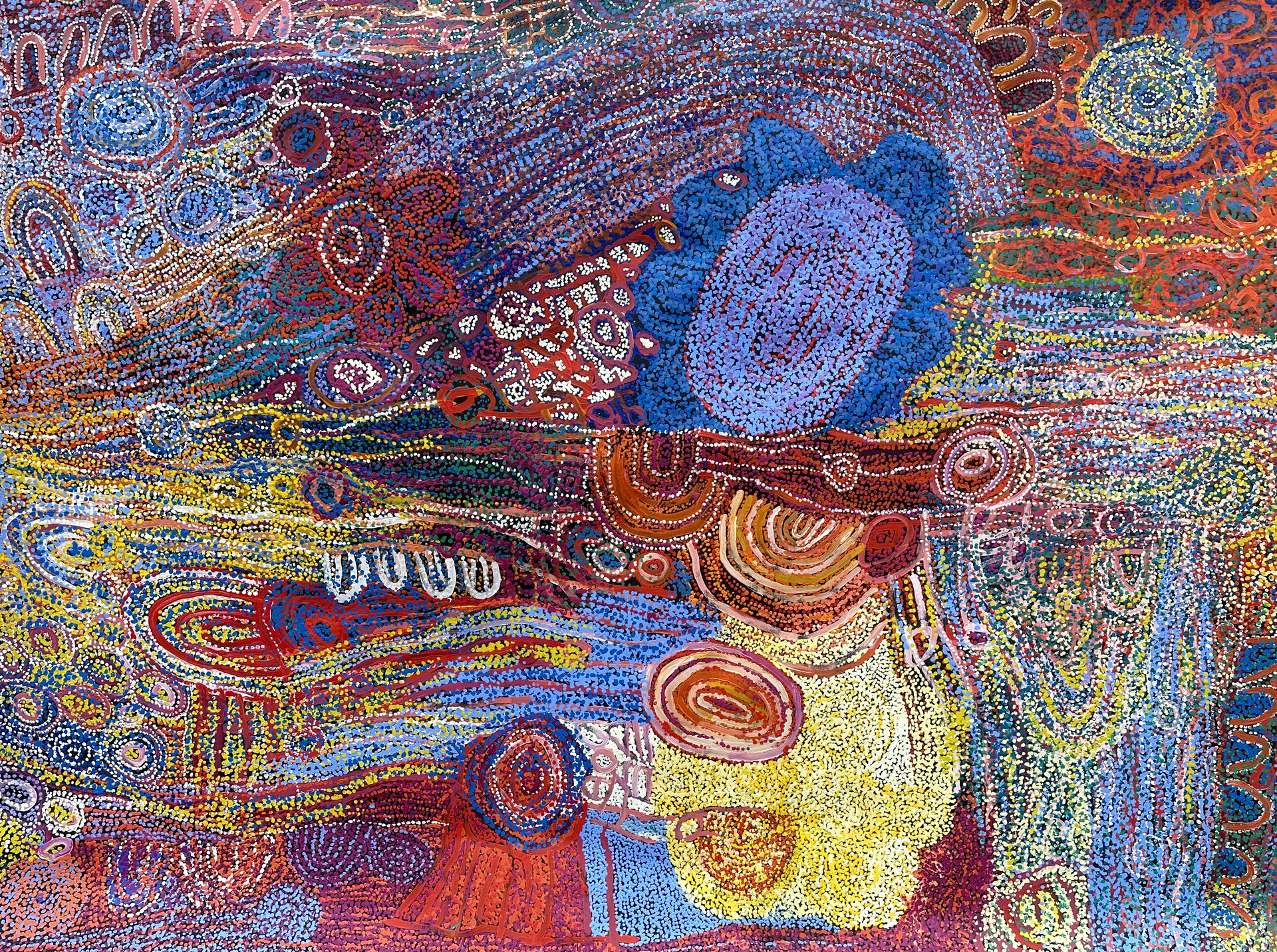
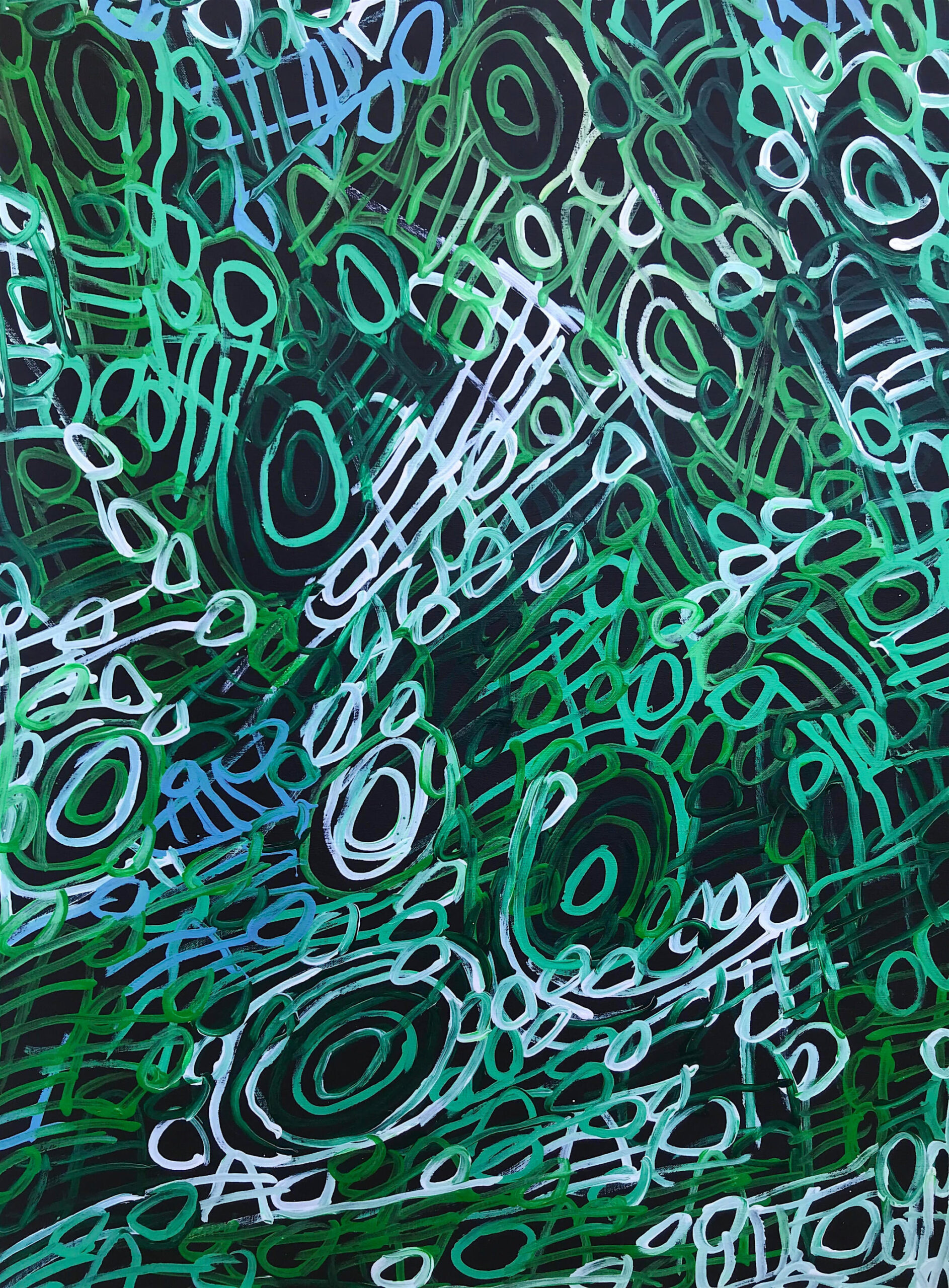
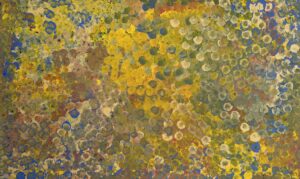
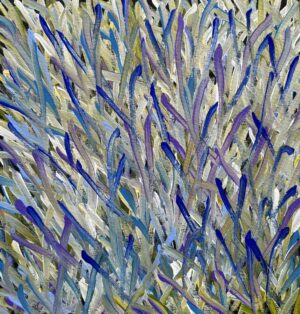
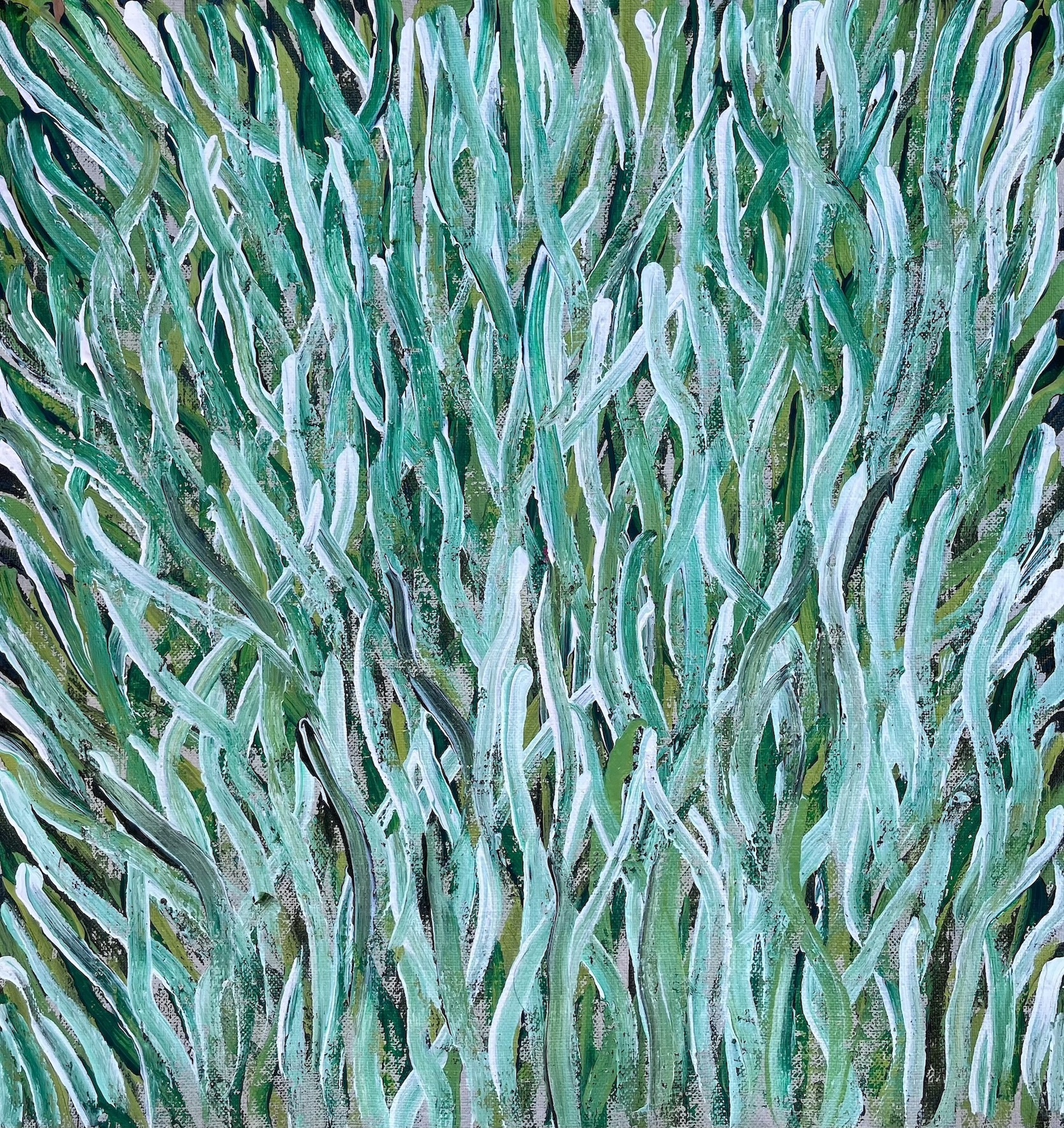
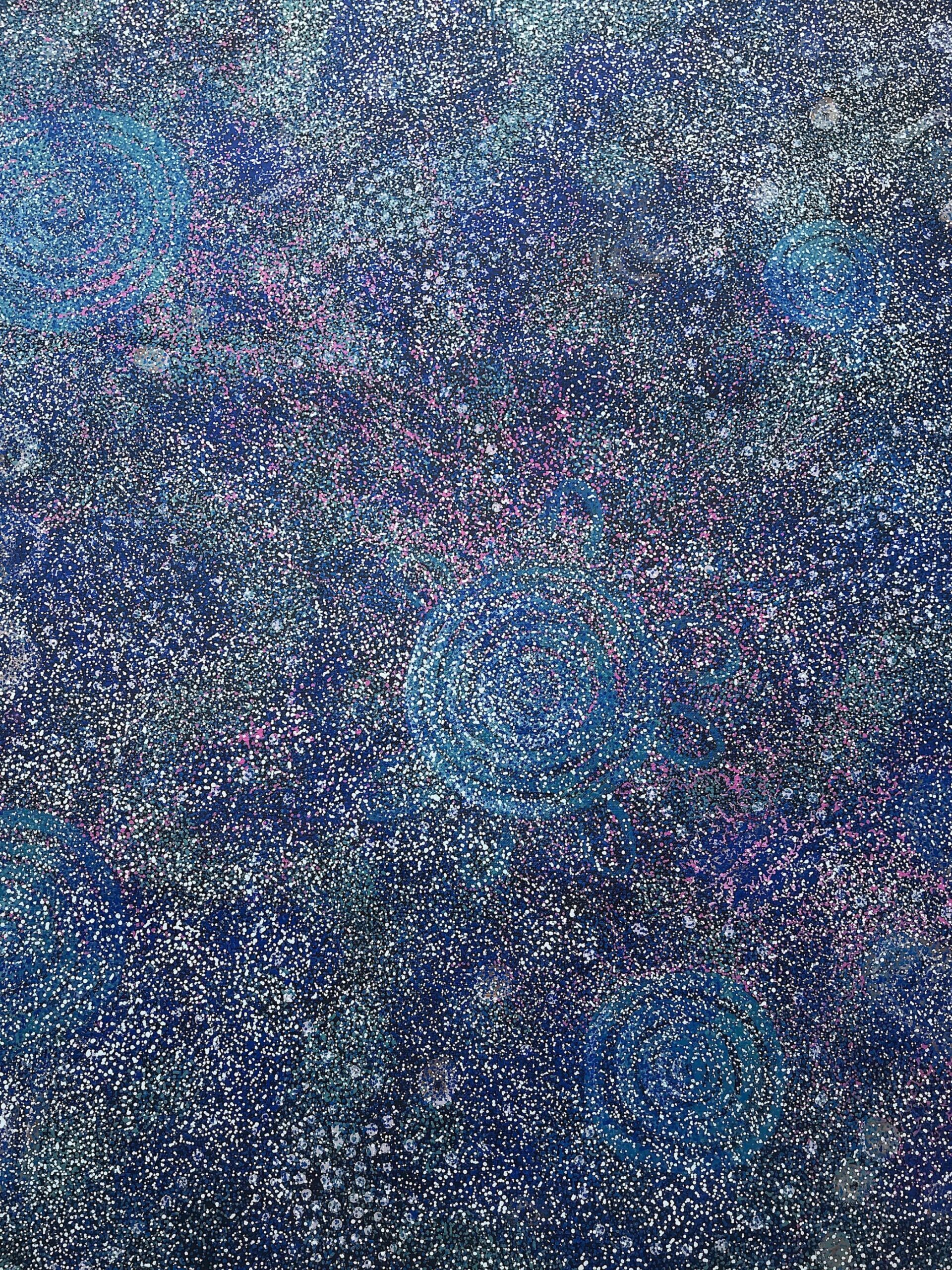
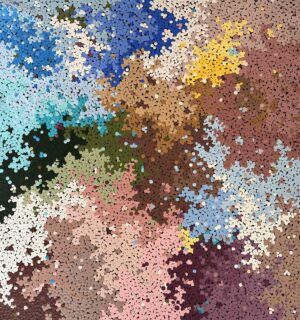
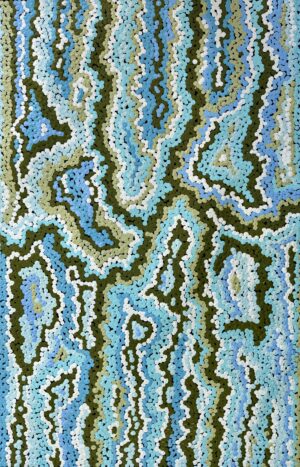
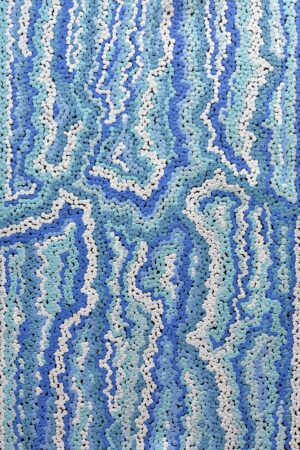
The rich colours Emily chose to paint ‘Earth’s Creation II’ represent many different aspects of her country of Alhalkere. Vibrant turquoise-greens signify the wet season, in which wild flowers bloom in profusion and create a mass of vivid colours across the land. Desert flowers may only last a few days, but all represent fertility, growth and regeneration, symbols of survival in harsh conditions. Her use of white was in homage to atnam, the colour of the seed of the atnwelarr yam of her main Dreaming and the source of her name. With a flourish of her brush she created the yellow flowers of the ground-cover yam plant. Her dots of rich reds echo the red sand of Alhalkere, and the ochres and browns evoke the long dry season when the hard-baked earth cracks beneath the sun’s glare and bush tucker struggles to survive.
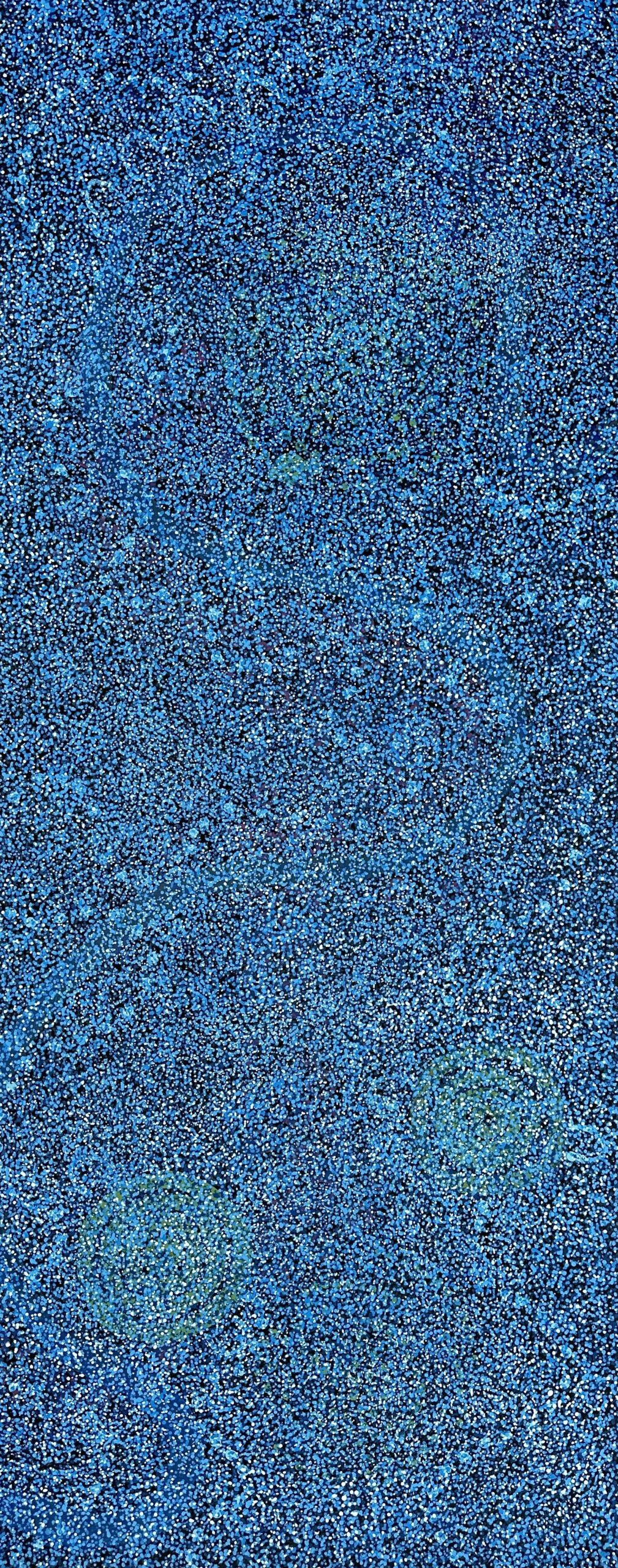
Emily’s expressive dotting is rhythmic and organic, mirroring the random growth of native plants in the semi-arid outback. The complex layering of the dots conveys seasonal abundance and her understanding of the land’s fecundity above and beneath the surface. Sitting cross-legged on the dry parts of the canvas or on the ground at its edges, she continually moved in and around the painting, using both hands, calling out for more jars of acrylic paints to layer colour upon colour as she created rich textures and depth. Her inventive technique to create her distinctive vivid flowers is rarely more evident than in this series of paintings. She dipped her brush in one jar then another to create the soft blending of colours. Barbara Weir recalled her memories of when Emily painted ‘Earth’s Creation’:
I was the cook. I did all the cooking and I was passing the paint ‘round and I mixed the paint for her. The canvas could be painted any colour for her to start painting on, as long as it wasn’t white. It could be painted black or whatever. She’d leave it and go and have her feed and lay down, then come back to it. The colours were just made there and just left, and whatever colour she’d go and pick it herself. She dipped that brush into it all different jars. She had one brush, then she’d put it into another colour, then dip that same brush into another colour and it all came out like this. She alternated hands in a single painting, first her left hand, then the right. Her left hand was the strongest. She often sang the painting while painting it, depending on how she felt when she was painting, who was there, whether she had an interest.
Every painting she did she had a story of new growth or after bush fire. Every painting had a story to it, so she told us that story so many times. She was a very frail woman if you saw her. When she painted ‘Earth’s Creation’ we were there for five or seven days and it was hot time. ‘Earth’s Creation’ was speed up and that’s how it came to be in panels ’cause nobody knew about these panels. Nobody else had these panels. It was something different. (Barbara Weir, interview with Victoria King, Adelaide, 1996).
Emily’s ‘Earth’s Creation’ paintings resonate with her profound connection to her country of Alhalkere. When she finished the canvas panels, she gave them to Fred, and with Barbara translating, told him this moving story of what these important paintings held and their significance:
"This is my place, my land, all my stories are in this painting. I grew up here from a little girl. I was taken away to work for a station owner and my soul was lost. Now I paint the land that owns me and that shows me how to paint from the inside out. It’s not just what you see on top but what’s beneath the ground, in the skies and the hidden treasures of the Dreamtime". (Emily Kame Kngwarreye, 1994, Utopia).
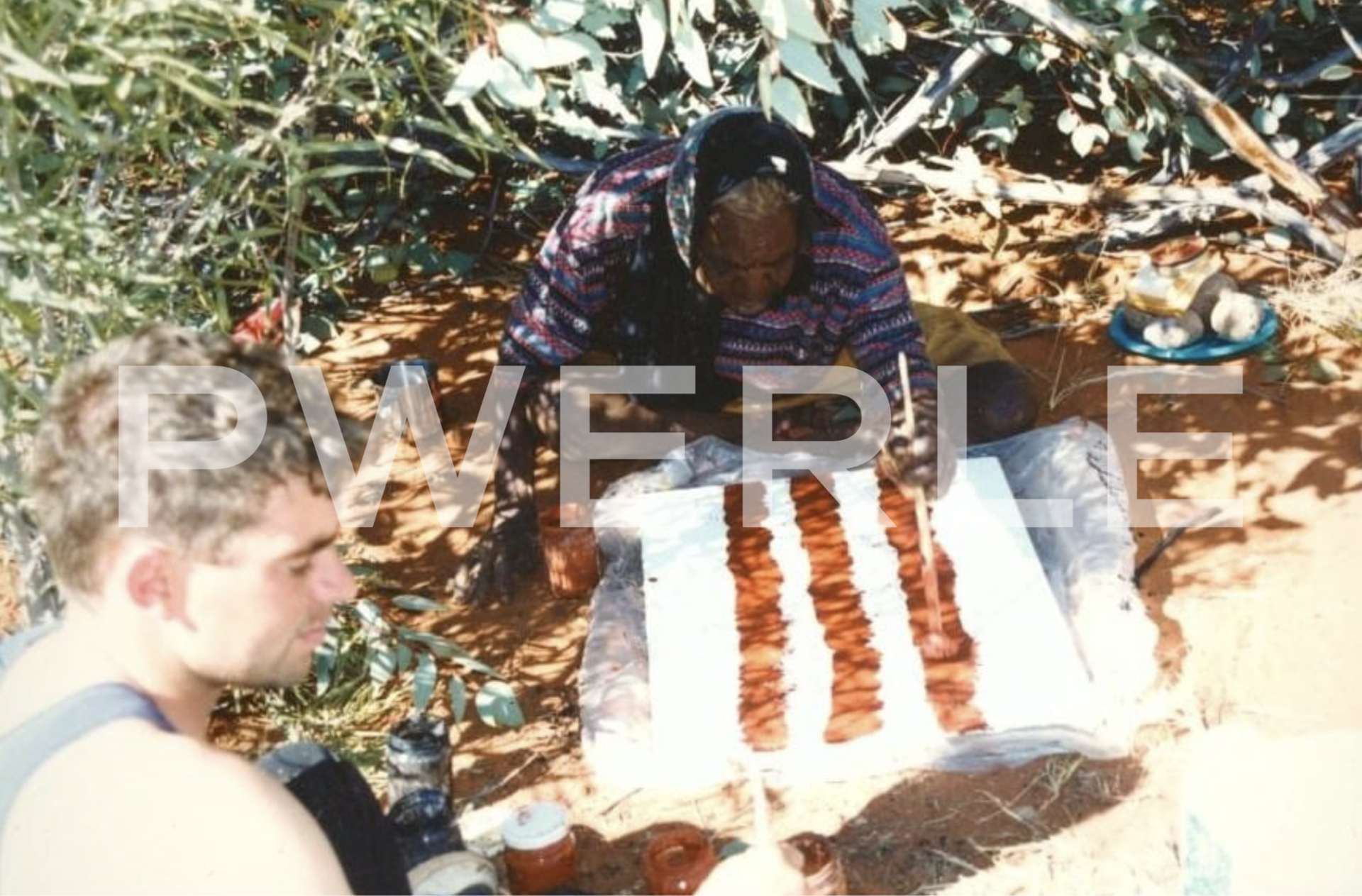
The Ochre Series represents one of the most culturally grounded and materially significant bodies of work by the late Emily Kame Kngwarreye; a senior Anmatyerre Law woman and one of Australia’s most celebrated contemporary artists.
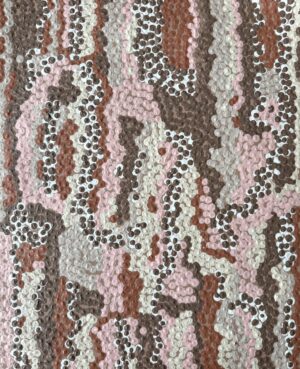
Created during the height of her career, these rare paintings are distinguished by their use of natural ochres and charcoal collected from Emily’s Country of Alhalkere, in the Utopia region of the Northern Territory. Traditionally, these pigments are ground and mixed with animal fat to create ceremonial Awelye body paint designs, applied to the breasts, shoulders, and torsos of Anmatyerre women during women’s ceremonies. In this series, Emily brought those same sacred earth materials onto canvas, bridging the ancient and the contemporary in a way that preserved the ceremonial significance while expanding its visual language for new audiences.
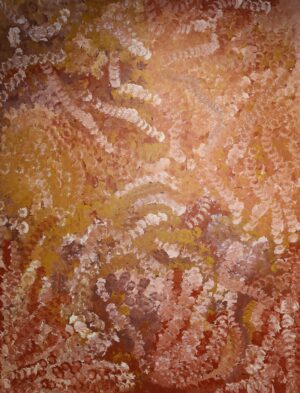
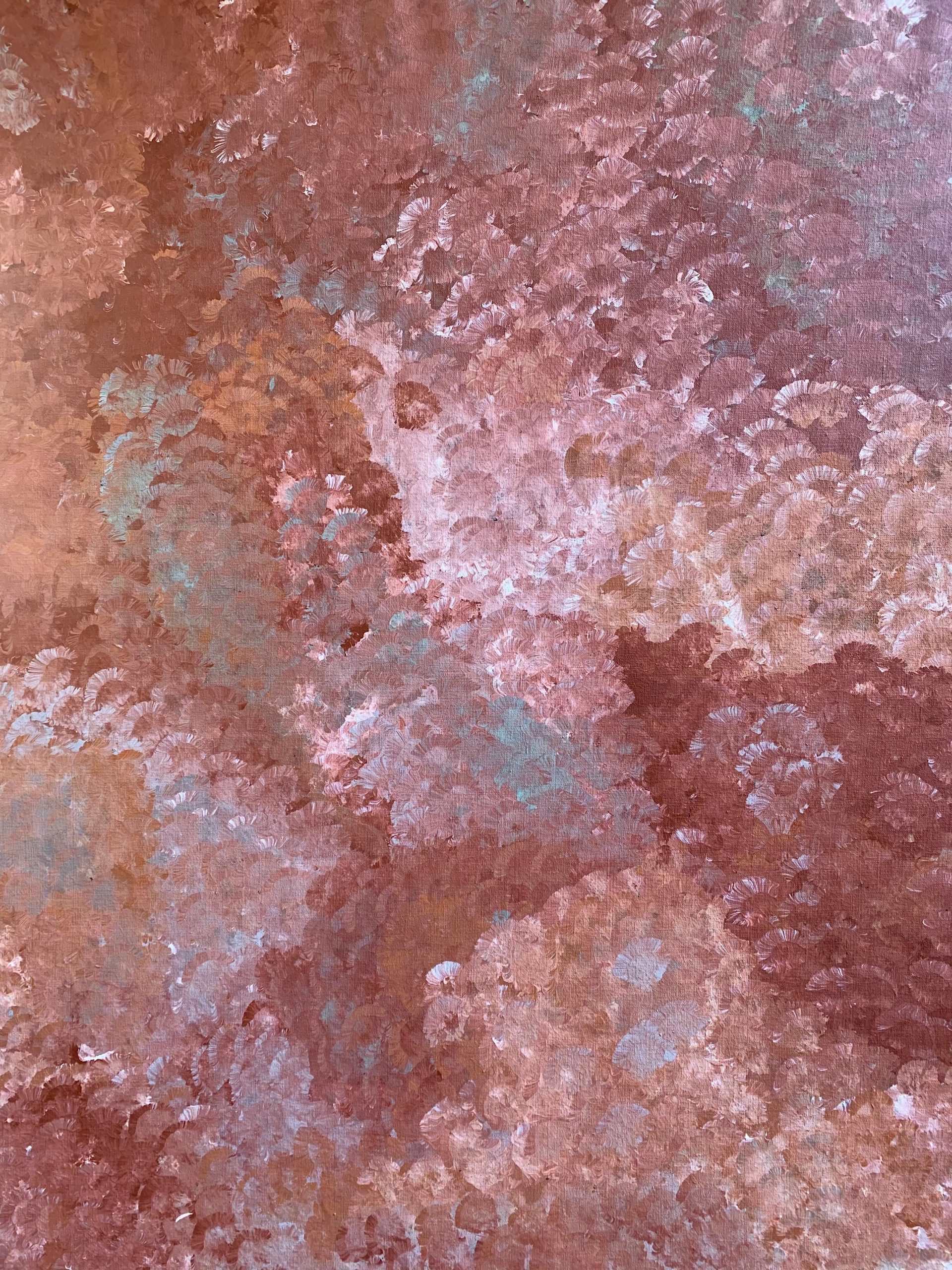
Each work in the Ochre Series carries the physical presence of her Country — the deep reds of the desert earth, the creamy yellows of the yam flower pollen, the stark white of her namesake kame (yam seed), and the dark charcoal tones of fire-cleared ground. These were not colours from a manufactured palette, but the very earth itself, lifted from Alhalkere and returned to the world through Emily’s hands.
The Ochre Series is also deeply tied to her Atnwelarr Yam Dreaming, her principal inherited story through paternal lineage. The lines, dots, and gestural sweeps in these works reference both the underground paths of the yam’s tubers and the ceremonial markings painted in ochre for Awelye. The result is a body of work that is not only visually striking but also an embodiment of cultural law, ancestral connection, and environmental knowledge.
Rarely seen in public exhibitions, the Ochre Series holds particular significance within our family’s custodianship. In bringing ochre and charcoal to the canvas, Emily reaffirmed her role as both innovator and tradition-bearer, demonstrating that contemporary Aboriginal art can speak to the global stage without severing its roots in Country and Law. The Ochre Series remains a rare and treasured chapter in her remarkable legacy.
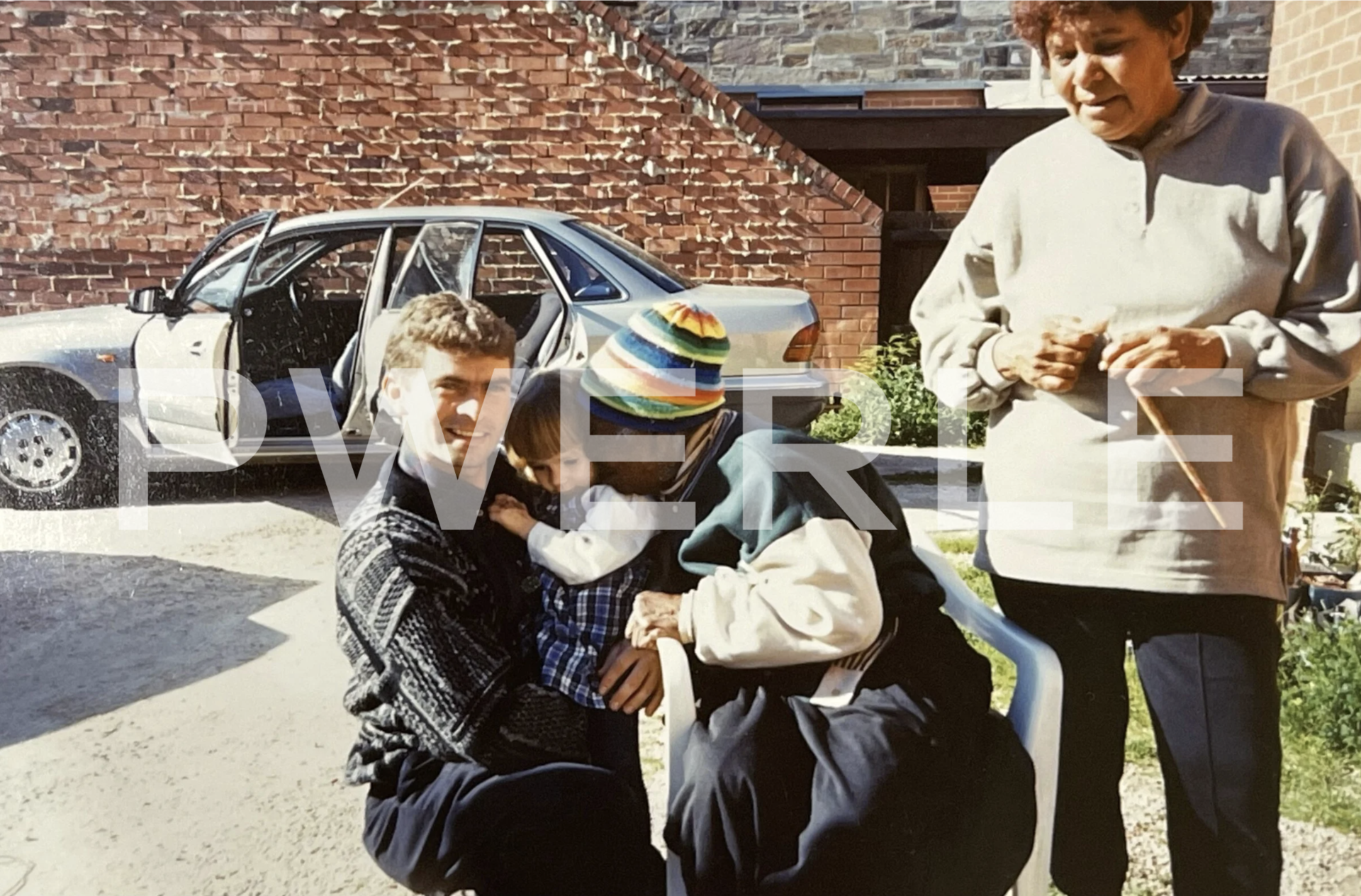
I first became aware of Emily’s work at the age of 12, when I witnessed the women working on their batiks at Three Bores. My mother Barbara Weir spent a lot of time with Emily who, in her words “grew her up”. It was only natural that Mum’s children would spend time with her as well. Although Emily is not closely related to our family, according to Aboriginal law Emily was my mother’s aunty. In white man’s terms this made her my great aunty. As a result the respect I had for Emily began from a young age. My first impression of Aunty Emily was that she possessed a formidable and wonderful will. Her pure inner strength shone through and this was reflected in her face. Emily’s face and hands always intrigued me as they were so expressive. Her hands were powerful from working on the land in her youth. It never ceased to amaze me that those same hands created the most wonderful pieces of art.
In the early 1980’s Aunty Emily lived and worked at one of the outstations in central Utopia known as “Three Bores”. In those days this was regarded as the main meeting place for the community. Emily and the other women would gather at the clinic to learn the process of applying their cultural knowledge to art of the Indonesian form of batik. This was a great hobby and was thoroughly enjoyed by Emily, who from the onset demonstrated a style different to the other ladies. Even though Aunty Emily applied the traditional symbols and colours to the batiks, she showed the extraordinary gift of being able to capture the very core of Aboriginal culture. This talent was to become the trademark of her work. What makes it even more incredible was that Emily was in her late seventies when she worked on batik.
My first experience with Aunty Emily painting on canvas was in 1991. A group of Utopia ladies, including Emily, came to stay with me in Adelaide. Although the trip was planned as a holiday, everyone wanted to paint while they were staying at the house. Very soon the backyard became an open studio with everyone painting the most amazing pieces of art. Aunty Emily was no exception and I witnessed her painting some incredible pieces. It was from this experience that the first stage of my art life was born and it was the start of an extraordinary career for Emily. The ladies had no idea how to sell their works, so they could have spending money while they were in Adelaide. Aunty Emily’s pieces were very strong and powerful and once the galleries had seen these works I found them eager to buy the paintings, and in no time at all the pieces had strong demand. After this short success Emily and the rest of my relatives wanted me to continue to sell their works. I agreed to do this by establishing my own gallery and naming it DACOU (Dreaming Art Centre of Utopia), where I represented Emily, Barbara Weir, Gloria Petyarre, Glory Ngarla and others.
Most of the time I had to travel to Utopia to organise and pick up various works. I had become very close to Aunty Emily and the other artists and the whole process of collecting the works was more fun than anything else. We would always go hunting first before we began to put together the makeshift workshops. These moments were filled with story telling and laughter between myself and the artists. At its heart, it was her love of Emily’s love of the land and her various Dreamings. It was also during these times that I realised my life had permanently changed and this full time occupation of collecting and distributing the work had become a passion.
After successfully operating DACOU Gallery in Adelaide for a couple of years in the early ’90s, it was clear to me that it was time to explore the interstate market. The interest for the Utopia artists was very strong and I had become passionate about promoting the artists. Emily Kngwarreye was the key to open up the doors to a new market. Working with close relatives who were keen, including my mother Barbara Weir, I thought we were ready to push our exposure to the next level. In 1994 I took a video recording of Emily Kngwarreye during a painting workshop in Alice Springs. This VHS recording showed footage of the creation of 18 yam paintings. It was an amazing series of paintings I was to cover commission from Emily in one single workshop. After meeting with Savah Hatzis at his gallery in Glenmore Road, Paddington we began a new journey into Emily’s career. It was within a short time that Gallery Savah held Emily’s first solo exhibition. It was a great success; it was very well received and completely sold out. These paintings have been admired all these years and so far have not been available for resale to the secondary market. Since then, DACOU has been involved in many exhibitions of Emily’s work in Australia and overseas.
Although Aunty Emily’s country was Alhalkere, she moved and lived around various places of Utopia. Even when she was quite elderly, Emily was able to get around from one outstation to another without any problems. She also enjoyed the occasional interstate travel, to attend exhibition openings or visit relatives. She was strong and healthy in body and soul. For Emily, painting was like a new breath of life. She came alive whilst painting.
Emily’s paintings can be interpreted on many different levels. Although her main Dreaming was about the yam, her paintings express all different aspects and stories about her culture. Emily’s paintings had a great importance to the social structure, ceremony and law relating to her country. Watching Emily paint hundreds of paintings allowed me to gain a real appreciation for art in a much broader sense.
Emily will always be one of my favourites, as I regularly witnessed a blank piece of canvas transform into a beautiful composition, and see stories about my Aboriginal heritage come alive through confident gestural brushstrokes and a multitude of colour. Her artwork gave a positive energetic atmosphere which is captivating for all who experience it. Emily had a way of combining colours and balancing a painting that came naturally to her. The works always came from inside her, progressing without having the end result in mind. Her creative process was a spiritual, almost ceremonial experience, often accompanied by her softly singing about the subject she was painting.
“This is my country, these are the wild flowers, this is women’s business”. Emily would always tell me what she was painting. The completion of each piece was always an interesting moment, as Emily could completely change a whole painting if she wasn’t satisfied with the end result. Emily had several ways of painting each of the styles that she painted but her most well known are the wild flower series and the yam series. As she changed her series throughout the years, Emily would sometimes revisit a previous style. It was amazing to watch her paint the monumental paintings that are now titled ‘Earth’s Creation’ in 1994. These four large works are painted in her famed ‘dump dump’ style: the wildflowers and a magnificent range of colours, mainly blue, green and yellow tones. ‘Earth’s Creation I’ the first painting from this series, a four panelled piece sold at auction and now hangs in the Mbantua Gallery museum in Alice Springs.
It was always fascinating to watch how she would choose her colours. I would prepare a wide range of paints for Emily and when preparing, Emily – in silence – would pick a selection of colours and push the other pots of paint aside. Then on other occasions Emily would use every colour she could lay her hands on. Watching Emily paint over the years was a pure pleasure and an upmost privilege. She had so much strength and energy and would always paint throughout the day until there were no canvases left. Most of the time you would have to hide the canvases, just so she could stop for the day to take a rest.
As we moved through the years there was a sequence of stylistic changes in her work. However, the yam always remained her main topic. Not many people realized that the linear composition of the yam paintings was often the basis of the wildflower paintings; these expressive fields of colour often have an underlay of the yam root structure. Using both small and large brushes Emily’s yam paintings were then layered many times, closing up the canvas and background until all of the canvas was filled with colour. From that extreme to the other, the open yam style which shows the linear root structure of the plant and leaves the background visible, which creates a floating effect. This is seen more so in the paintings where Emily has only used black and white. This is a fine example of the increasing abstraction of her work over the years. This universal artistic process has defined many great artists in the 20th century, all over the world.
The last time I saw Aunty Emily was in August 1996 – a few weeks before she died. Emily asked me to go to Utopia as she felt like painting. I was hesitant at first as she had been very ill, but she was very insistent. I took some canvases and materials and it was there Aunty Emily painted the last series of works titled ‘My Country’ using a six-inch priming brush. In a last dramatic change of style Emily painted large blocks of colour, which she explained to me was the country beside the hill with the hole through it: ‘my country’ (Alhalkere). As the canvas filled with wet paint I could see the satisfaction in Emily’s expression as her enthusiasm kept growing with each new work that she was creating. When Emily had finished the canvas she asked me to pull it away somewhere to dry and would start painting on the next canvas straight away. In amazement I watched, not really understanding the importance of what was unfolding before my eyes. When the workshop finished I was filled with excitement. These 24 pieces are unique for many reasons: the extraordinary style change which resulted in a perfection of her natural movement towards abstraction. These works have often been discussed, written about and compared to. They have been exhibited all over the world and have become highly sought after by art collectors. The big bold beautiful colours have clear definition, showing slight variation of colour through each stroke of the brush. I witnessed what I regard as the last burst of creative spirit from a woman who blazed onto the art scene, and in the space of ten years left an unforgettable impression.
This last series of works are no exception and is testament to her amazing ability. Aunty Emily passed away on 2nd September 1996, and just as she had touched my life, I am sure she will continue to touch other peoples’ lives through her work – a fitting reminder of an incredible woman.
Throughout this website, Pwerle Gallery and the Kngwarreye family use the spelling Emily Kame Kngwarreye, reflecting the spelling used by Emily during her lifetime, by her family and on her gravestone.
The family considers this spelling an important part of Emily's identity and legacy and continues to use it in accordance with longstanding family practice and historical records associated with her life and career. The family also understands that Emily wished her name to continue to be represented in the form she used throughout her lifetime.
Exhibition titles, publications and institutional references are reproduced as originally presented by the organising institution and may therefore contain alternative spellings of Emily's name, including Emily Kam Kngwarray.