| DREAMING | |
|---|---|
| SIZE | 66 × 76 cm |
| YEAR | |
| Weight | 0.8 kg |
| colour |
To request a commision, please email us at hello@pwerle.com.au.


Trevor Nickolls (1949–2012) was a pioneering Ngarrindjeri artist from Adelaide whose work helped shape the field of urban Aboriginal art in Australia. Trained at the South Australian School of Art and later at the Victorian College of the Arts, he developed a distinctive visual language that blended traditional Aboriginal iconography with contemporary imagery. Influenced early on by senior Pintupi painter Dinny Nolan Tjampitjinpa, Nickolls experimented with dotting, cross-hatching, and symbolic motifs while responding to the social and cultural shifts of post-war Australia.
His practice became defined by the concept of “Dreamtime–Machinetime,” which explored the relationship between the spiritual world of the Dreaming and the realities of modern, industrialised life. In vibrant and layered compositions, ancestral figures, animals, and landscapes were set against cityscapes, satellites, and machinery, reflecting both the tensions and the resilience of Aboriginal identity in contemporary society. This bold vision placed Nickolls at the forefront of the late 1970s and 1980s urban Aboriginal art movement.
Nickolls’ career reached a historic milestone in 1990 when he, alongside Rover Thomas, represented Australia at the Venice Biennale — the first Aboriginal artists to be included in the Australian Pavilion. Over the decades he exhibited widely in Australia and abroad, culminating in the major survey exhibition Other Side Art: Trevor Nickolls — A Survey of Paintings and Drawings 1972–2007. His works are now held in every major Australian state gallery and in key international collections. Remembered for his generosity and innovation, Nickolls left behind a legacy that continues to inspire, standing as a bridge between tradition and modernity in Aboriginal art.
Learn more about Trevor Nickolls here.
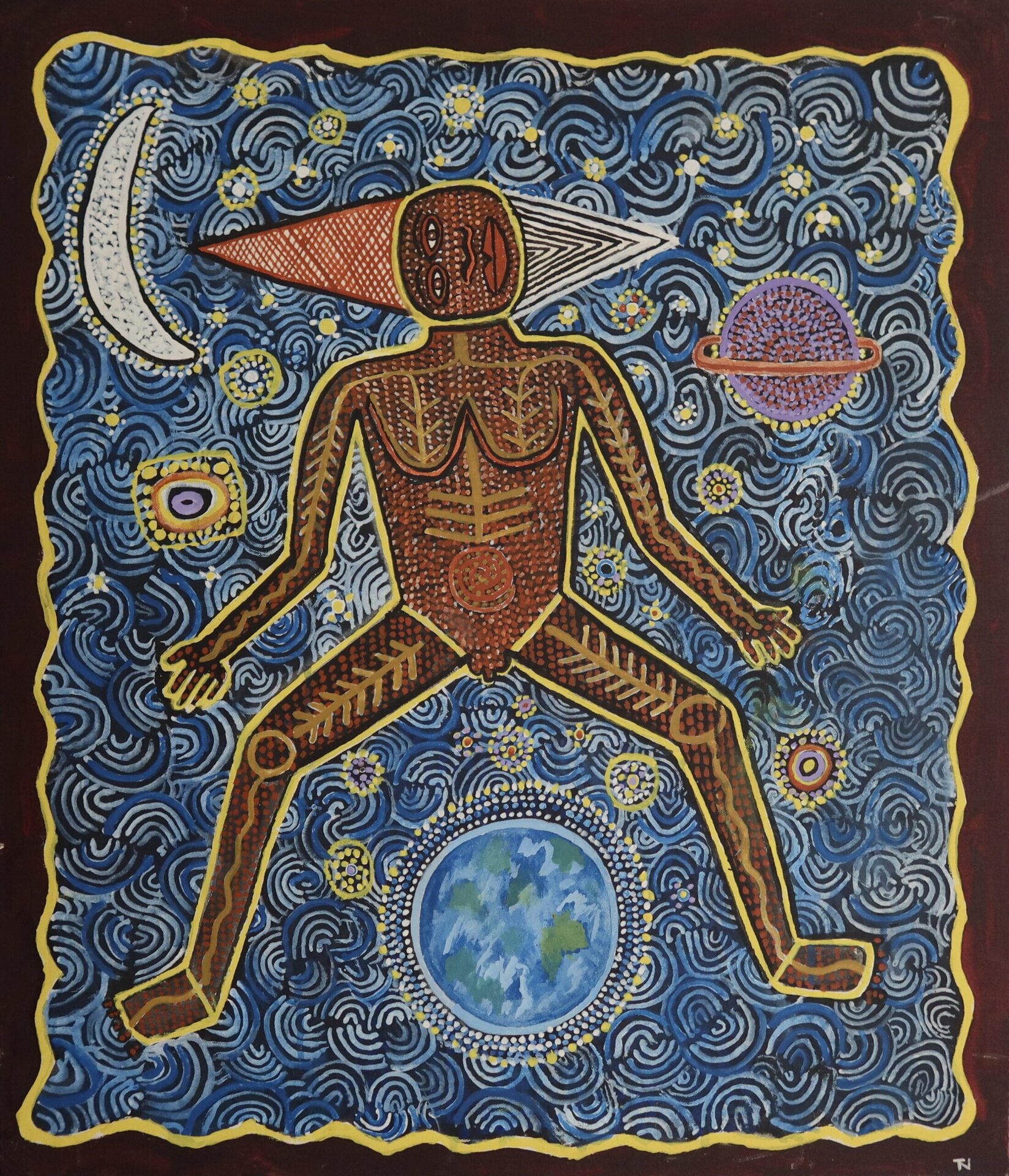
Painted in 1989, this work measures 88cm x 76cm. It is currently stretched and ready to hang, with the artist’s signature featured on the canvas.
Dreamtime–Machinetime is the central philosophy and signature theme of Trevor Nickolls’ career — a concept he both coined and lived through his work. It represents the meeting point of two worlds: the ancient spiritual dimension of Aboriginal Dreaming and the modern, mechanised environment of contemporary life.
In Nickolls’ vision, these worlds are not entirely in opposition but exist in a constant state of negotiation. His paintings often weave together elements such as sacred landscapes, ancestral spirits, and totemic animals with visual markers of the modern city — bridges, highways, power lines, and skyscrapers. This interplay challenges viewers to consider how Aboriginal culture adapts to modern contexts without losing its spiritual foundation.
In Dreamtime–Machinetime, the viewer is taken on a journey that spans millennia, revealing the enduring relevance of cultural knowledge in navigating the present and shaping the future.
Trevor in his own words at the time he produced this piece, titled it: ‘Man fucking up the world’.
Learn more about this dreaming here.
Each artwork is meticulously created using the highest quality materials to ensure longevity, vibrancy, and integrity over time.
Artists work with premium linen canvas, selected for its durability and fine texture, paired with professional-grade acrylics and hand-picked brushes. This combination allows for both bold expression and intricate detail, preserving the richness of the stories embedded in every piece.
All materials are archival and museum-quality.